Meezan Bank and Chapal Builders Enter into A Strategic Alliance

Meezan Bank and Chapal Builders Enter into A Strategic Alliance for Providing Shariah-Compliant House Financing Solutions to Potential Customers

Karachi (Muhammad Yasir) Meezan Bank, the Best Bank in Pakistan has recently signed a Memorandum of Understanding with Chapal Builders & Developers, one of the oldest real estate builders and developers in Pakistan, to offer Shariah-compliant housing finance solutions for Chapal’s flagship residential project – Chapal Courtyard.

The MoU was signed by Mr. Arshad Majeed, Group Head Consumer Finance – Meezan Bank and Mr. Jawad Chapal, Director – Chapal Builders at the project’s site location, adjacent to Chapal Sun City near Safoora Chowk, Scheme 33, Karachi. The event was also attended by Mr. Ahmed Chapal, Director – Chapal Builders and Mr. Faisal Saifullah, Head Housing Finance – Meezan Bank.

Under this MoU, Meezan Bank will offer customised Shariah-compliant housing finance solutions to customers who intend to purchase apartments in Chapal Courtyard. Being the pioneer of Islamic Housing Finance in Pakistan, Meezan Easy Home product has been refined to enable all the segments of society to have easier access to this facility. Furthermore, in order to support the Prime Minister’s vision of providing low-cost housing facility for masses, Meezan Bank is continuously striving towards making financing more viable to the masses through specialized Shariah-compliant solutions for potential customers.

Commenting on the occasion, Mr. Arshad Majeed said “Meezan Bank is committed to expanding its product offering to make Shariah-compliant housing finance affordable and reachable to many Pakistanis through convenient and competitive banking solutions.” 

Mr. Ahmed Chapal, while commenting on the occasion said “Chapal Courtyard is a one-of-its-kind residential project offering a state-of-the-art facility at a very attractive price, having covered area of up to 1,200 sq. ft. The project comprises of 300 elegantly designed apartments in a secured residential community with modern amenities and facilities, encompassing stand-by generator, green area, community centre, cafeteria, gym, library, mosque, etc. We are pleased and delighted to have Meezan Bank as our banking partner and thank them for designing a Shariah-compliant product catering specifically for our customers.”

Next Generation of Oracle Autonomous Data Warehouse Available

Provides easy-to-use, no-code tools that empower Data Analysts to do tasks that previously required data engineers and data scientists

 Puts faster, more powerful insights within the reach of organizations of all sizes

 Lahore (Muhammad Yasir) Today Oracle announced a set of innovative enhancements to Oracle Autonomous Data Warehouse, the industry’s first and only self-driving cloud data warehouse. With this latest release, Oracle goes beyond other cloud offerings by completely transforming cloud data warehousing from a complex ecosystem of products, tools, and tasks that requires extensive technical expertise, time and money to perform data loading, data transformation and cleansing, business modeling, and machine learning into an intuitive point-and-click, drag-and-drop experience for data analysts, citizen data scientists, and business users. As a result, Oracle Autonomous Data Warehouse empowers organizations of all sizes—from the smallest to the largest—to get significantly more value from their data, achieve faster results, accelerate insights, and improve productivity while lowering costs with zero administration.

The latest enhancements to Oracle Autonomous Data Warehouse provide a single data platform built for businesses to ingest, transform, store, and govern all data to run diverse analytical workloads from any source, including departmental systems, enterprise data warehouses and data lakes.

“Oracle Autonomous Data Warehouse is the only fully self-driving cloud data warehouse today,” said Andrew Mendelsohn, executive vice president, database server technologies, Oracle. “With this next generation of Autonomous Data Warehouse, we provide a set of easy-to-use, no-code tools that uniquely empower business analysts to be citizen data scientists, data engineers, and developers.”

Citizen data scientists and analysts will also benefit from powerful new self-service graph modeling and graph analytics. To empower developers to build data-driven applications, Oracle offers Oracle APEX (Application Express) Application Development, a low-code application development tool built directly into its cloud data warehouse, as well as RESTful services, which makes it easy for any modern application to interact with warehouse data. Unlike other vendors’ single-purpose, isolated databases in the cloud, Oracle Autonomous Data Warehouse provides support for multi-model, multi-workload, and multi-tenant requirements—all within a single, modern converged database engine—including JSON document, operational, analytic, graph, ML, and blockchain databases and services.

New Innovations in Oracle Autonomous Data Warehouse

The latest release includes many new innovations, not only a broad set of capabilities that make it easier for analysts, citizen data scientists, and line-of-business developers to take advantage of the industry’s first and only self-driving cloud data warehouse, but also features that deliver deeper analytics and tighter data lake integration. Key capabilities include:


  • Built-in Data Tools: Business analysts now have a simple, self-service environment for loading data and making it available to their extended team for collaboration. They can load and transform data from their laptop or the cloud by simply dragging and dropping. They can then automatically generate business models; quickly discover anomalies, outliers and hidden patterns in their data; and understand data dependencies and the impact of changes.
  • Oracle Machine Learning AutoML UI: By automating time-intensive steps in the creation of machine learning models, the AutoML UI provides a no-code user interface for automated machine learning to increase data scientist productivity, improve model quality and enable even non-experts to leverage machine learning.
  • Oracle Machine Learning for Python: Data scientists and other Python users can now use Python to apply machine learning on their data warehouse data, fully leveraging the high-performance, parallel capabilities and 30+ native machine learning algorithms of Oracle Autonomous Data Warehouse.
  • Oracle Machine Learning Services: DevOps and data science teams can deploy and manage native in-database models and ONNX-format classification and regression models outside Oracle Autonomous Data Warehouse, and can also invoke cognitive text analytics. Application developers have easy-to-integrate REST endpoints for all functionality.
  • Property Graph Support: Graphs help to model and analyze relationships between entities (for example, a social network graph). Users can now create graphs within their data warehouse, query graphs using PGQL (property graph query language) and analyze graphs with over 60 in-memory graph analytics algorithms.
  • Graph Studio UI: Graph Studio builds on property graph capabilities of Oracle Autonomous Data Warehouse to make graph analytics easier for beginners. It includes automated creation of graph models, notebooks, integrated visualization and pre-built workflows for different use cases.
  • Seamless Access to Data Lakes: Oracle Autonomous Data Warehouse extends its ability to query data in Oracle Cloud Infrastructure (OCI) Object Storage and all popular cloud object stores with three new data lake capabilities: easy querying of data in Oracle Big Data Service (Hadoop); integration with OCI Data Catalog to simplify and automate data discovery in object storage; and scale-out processing to accelerate queries of large data sets in object storage.

What Customers Are Saying

“By using Oracle Analytics Cloud and Autonomous Data Warehouse, we’re able to apply machine learning and spatial analysis to better track check cashing behavior that mitigates risk and prevents fraud in real-time to help businesses and consumers more confidently engage in commerce,” said Eric Probst, Senior Manager, Fraud Analytics, Certegy.

“With Oracle Autonomous Data Warehouse and APEX, I not only have a world-class, scalable, super-secure, super-powerful database engine, but with the built-in application development tools, I can also build and deploy applications almost right away so that I can get people access to data,” said Frank Hoogendoorn, Chief Data Officer, MineSense. “I don’t know of any other platform where I can do that out of the box.”

“Having innovative capabilities for loading data that’s built right into Oracle Autonomous Data Warehouse should save us a tremendous amount of time,” said Derek Hayden, SVP of Data Strategy and Analytics, OUTFRONT Media. “The declarative extract, load, and transform with its drag-and-drop functionality will enable us to quickly load and transform multiple data types, and see the relationships within the data through the auto-insights capability.”

“Oracle Autonomous Data Warehouse has reduced time-to-market for a typical data warehouse project from three months to three days, while delivering deeper and more actionable insights,” said Steven Chang, CIO, Kingold. “Being able to benefit from increased automation for data ingestion, transformation, building business models and getting insights is excellent news, and we’re looking forward to using those capabilities.”

What Analysts Are Saying

“Our research, based on interviews with several customers around the globe, shows that those Oracle Autonomous Data Warehouse customers have achieved approximately 63 percent reduced total cost of operations, while increasing the productivity of data analytics teams by 27 percent, with breakeven on their investment having occurred in an average of five months,” said Carl Olofson, Research Vice President, Data Management Software, IDC. “This ROI included significant productivity gains across data, analytics, and developer teams. While individual customer results may vary, the benefits found in this study are indicative of the kind of improvements that most may expect. With these new intuitive integrated tools incorporated in Oracle Autonomous Data Warehouse, it is reasonable to expect that productivity gains will further increase, enabling businesses to achieve an even better ROI.”

“Oracle Autonomous Database in all its flavors continues without a response from competitors even after three years in the market,” said Holger Mueller, Vice President and Principal Analyst, Constellation Research. “Now Oracle is adding to that lead with enhancements to Oracle Autonomous Data Warehouse that aim to democratize all aspects of analytics and machine learning by eliminating the need for users to know SQL. Instead, Oracle provides drag-and-drop UIs and AutoML for building and testing machine learning models, so that business users can do their own data explorations without depending on IT, DBAs, or system administrators to manage the data. All of this is built on Oracle’s converged database foundation which gives users access to all data models and types within a single database.” 

“The objective of IT automation is to remove IT from the day-to-day workflows and allow the lines of business to work directly to define and mine the data that matters,” said David Floyer, CTO & Co-founder of Wikibon. “The Oracle Autonomous Data Warehouse now allows end-users to use drag-and-drop and low-code technologies to define the data requirements for a wide variety of end-user tools such as Tableau and Qlik. Oracle Autonomous Data Warehouse has improved spatial, graph, and ML analytics available on-premises or in public clouds with improved real-time performance. Oracle is cool again.”

“Oracle continues to make life dramatically easier for anyone associated with data and its value,” said Mark Peters, Principal Analyst & Practice Director, Enterprise Strategy Group. “Having started by helping DBAs and system administrators with its self-driving Autonomous Database, Oracle is now broadly extending the productivity and efficiency benefits of its Autonomous Data Warehouse so that everyone from data analysts, citizen data scientists, and business users can leverage it in easy and familiar ways. The drag-and-drop UIs and low-code interfaces simplify everything from data loading and analysis to building machine learning models. While Oracle’s competition—which often still requires extensive expertise, third-party tools or retrieving data manually from external databases—has work to do to better address the needs of non-technical personas, Oracle is there now.” 

“Enabling data analysts, citizen data scientists, and business users to create and analyze their own data sets with self-service tools avoids IT bottlenecks and significantly improves their productivity. This is exactly what Oracle has done with its enhancements to Autonomous Data Warehouse,” said Bradley Shimmin, Chief Analyst, Omdia. “Oracle is equipping integrated tools with intuitive drag-and-drop interfaces that make it easier for data analysts to load, transform, and clean data; further, they can leverage machine learning to automatically create business models and discover patterns, thereby generate insights—leading to better and faster business decisions.”

“Just as some data warehouse clouds are trying to figure out how they play well with machine learning, Oracle has moved the goal posts by a lot,” said Marc Staimer, President of DS Consulting and Wikibon analyst. “Oracle’s Autonomous Data Warehouse now includes Auto-ML. Oracle Autonomous Data Warehouse has included built-in machine learning since its inception. But now they’ve automated it so any Autonomous Data Warehouse customer can use it without any expertise. This makes other offerings seem rudimentary and primitive by comparison.”

“Oracle’s enhancements to Autonomous Data Warehouse are significant in three ways. First, it provides point-and-click user interfaces and machine learning automation, enabling non-professionals to generate actionable insights. Second, with this ease-of-use, even SMBs with small IT departments can get benefits from Oracle’s sophisticated cloud data warehouse. And, third, with Autonomous Data Warehouse, users can ingest data from any source from departmental systems to enterprise data warehouses, data lakes, and even from other clouds—AWS, Azure, and Google—and run diverse analytical workloads,” said Richard Winter, CEO and Principal Architect. “All in all, Oracle is materially extending the reach of Autonomous Data Warehouse across users, organizations, and data access to multi-clouds. This transcends the barriers of what is possible today with AWS Redshift and Snowflake and any other cloud data warehouse on the planet.”

 

“KuppingerCole has recognized Oracle’s continued innovation in database technologies, naming Oracle Autonomous Database the Overall Leader in our Leadership Compass on Enterprise Databases in the Cloud last year,” said Alexei Balaganski, Lead Analyst, KuppingerCole Analysts. “Clearly, the company did not stop there. With the unveiling of the improved Autonomous Data Warehouse, Oracle continues to deliver on its vision to democratize data management, analytics, and security for organizations of any size or industry. These new features and enhancements allow every user to access any data and obtain insights close to real-time with intelligent self-service tools. The company’s ‘converged database’ approach ensures that all types of data are accessible at once, as opposed to the siloed nature of traditional analytics platforms. This helps businesses to avoid the exposure of sensitive information to unnecessary security and compliance risks.”


Karandaaz and Haball to run a Pilot to Scale Supply Chain Payments Project

Digitizing all Supply Nodes in a Retail Value Chain Vital for Higher Acceptance of Digital Payments

Lahore (Muhammad Yasir) Karandaaz Pakistan, under its Pilot to Scale Program has partnered with Haball, a B2B financial technology company, to run a project that proves the significance of digitizing all supply nodes in the retail value chain for higher acceptance of digital payments. Under this particular grant, Haball, in collaboration with a corporate entity and branchless banking wallet provider will digitize an entire value chain enabling distributors and their retailers to order and make payments digitally from manufacturers to end-consumers. The hypothesis for this pilot project is that the acceptability of digital payments increases if supply chain players from manufacturer to distributor and retailer and to the end consumer are all using digital payment platforms. For the purposes of the pilot, Haball will create an ecosystem where payments are made digitally from corporate to retailer level and vice versa. Since retailers will be enabled with digital wallets for making value chain payments, this, in turn, will help them receive payments digitally as well, and the end-consumers will also be able to make digital payments for everyday household items.

The pilot is expected to prove that while the paper-based payment instruments bring with them a host of problems, including manual reconciliation, which is prone to errors and delays and can be taxing for downstream retailers and merchants, enabling retailers to digitally accept payments is not possible with singular efforts of microfinance institutions and telcos. In order to increase the uptake, a holistic institutional approach involving multiple parties is needed to make sure that all the nodes are streamlined.

Ali Sarfraz, CEO Karandaaz Pakistan said, “Karandaaz is currently running multiple programs to support the digital financial services sector of Pakistan and build models and solutions for the financial inclusion of the unbanked and underbanked population. In addition to empowering those who do not have an account, we have specific programs that target the underbanked population with pilots that introduce financial deepening to such segments. Karandaaz Pilot to Scale projects in partnership with different private sector entities are supporting the overall digital financial services ecosystem in the country by making it possible to test innovative ideas for viability in the Pakistani market and scale the successful ones and disseminate learnings for wider use. I am happy to note that under this project, Haball is taking a top-down approach and its partner corporate will mandate the uptake of digital payments for the whole supply chain. Such a solution can have a far-reaching impact. The SMEs involved in the value chain will be able to have easier access to finance as lending institutions will have a better view of the businesses’ existing financial position. This also means that these formal lending institutions can offer customized loan and lending products for each individual business in any supply chain.”

Rehan Akhtar, Chief Digital Officer of Karandaaz Pakistan said, “The categories for Pilot to Scale projects have emerged based on the learnings from the past interventions undertaken by Karandaaz in partnership with the private industry from 2016 to 2019 and the white spaces in the market. The value chains in focus under this pilot to scale grant project are from agriculture, retail, and manufacturing sectors and the private sector institutions including banking and non-banking financial institutions, FMCGs, logistics companies, fintechs, B2B service providers, value chain aggregators, and platforms, etc. can apply for grants under this program. The objective of focusing on these categories is to broaden the horizon of Karandaaz interventions and include all major efforts, in addition to payments.”

Speaking about the significance of this grant, Omer Bin Ahsan, CEO Haball said, “Partnership with Karandaaz is to achieve mutual goals that are financial inclusion and promotion of digital payments by integrating tightly into each value chain. We are also leveraging our partnership with Karandaaz to involve relevant financial institutions to integrate with the value chain directly. This shall enable frictionless supply chain payments under this pilot and enhance the digital payment canvas. Haball Pvt. Ltd. is a B2B financial technology company focused on eliminating manual order processing, reconciliation, and paper-based payment methods that bloat up the cost of doing business.”

Women’s transition into financial inclusion is often held back by the psychological barriers they face that may include hesitation in attending training events due to the unequal gender ratio at the training centers or the absence of a local support system in the form of female change agents. Haball has planned to employ women brand ambassadors as part of the on-ground activation in the targeted locations. This on-ground team will conduct training sessions for women on how to use the existing technology for making payments, gather data on which use-cases can facilitate uptake of digital payments amongst women, and encourage customers including women to open mobile wallets and transact with retailers digitally.

According to the State bank of Pakistan’s Quarter-3, FY19 Report, Real-Time Online Branches (RTOBs) had the highest share in the value of transactions, roughly 82.2% – 236.1 million transactions of value PKR 17.5 trillion. This channel is mostly used for value-chain payments and has only decreased by 10% in the last 13 years.

Karandaaz Pakistan is currently accepting new proposals under this Pilot to Scale Program in the categories of digital payments, digitizing payments in value chains, and use-cases of digital channels. Entities that already have a play in the value chain, have a focus on innovative solutions for digitizing payments either in down-stream part or up-stream part or both and commit to using learnings from this pilot to scale their operations can apply for grants under this program.

realme set to launch Narzo 30A with MediaTek Helio G85 processor

The young and trendsetting technology company, realme continues to bring remarkable technology at a cost-effective price. The brand shall be launching its Gaming phone realme Narzo 30A with MediaTek Helio G85 processor and 6000mAh Mega battery. The launch will be held on realme’s Official Facebook page on March 21, 2020, at 12.00 pm. The phone will be exclusively available on Daraz.pk only. It is going to be the best gaming phone for mobile gamers under the price of PKR 25,000.

For the past two years or so, realme has worked hard to bring the latest technology and innovative lifestyle products to Pakistan. The young and trendsetting smartphone brand always brings cutting-edge technology, advanced camera, fastest charging, and an overall superior experience to all its fans. The Narzo series is realme’s “performance series” and has already launched three models for the Narzo series globally, including realme Narzo, Narzo 20, and Narzo 20 pro. 

Narzo phones have a powerful processor that helps facilitate every young user. The latest successor from the series, Narzo 30A will be featuring a MediaTek Helio G85 processor with a 12nm Octa-core 64bits Processor and 200000+ Antutu Benchmark, a 6000mAh Mega battery, a larger display, and other amazing features. The phone is expected to be the ultimate choice of gamers as it provides the smoothest and efficient gameplay.

MediaTek is the 4th largest fabless semiconductor company globally. It powers more than 2 billion connected devices annually and has become a market leader in developing advanced systems-on-chip (SoC) for mobile devices, home entertainment, connectivity, and IoT products. MediaTek Helio G-series chips feature HyperEngine Game Technology to deliver sustained performance and longer gameplay. The MediaTek Helio G85 pumps its Arm Mali-G52 GPU up to 1GHz, while MediaTek HyperEngine provides whole smartphone enhancements, blasting performance for avid mobile gamers.

Narzo 30A with the powerful MediaTek Helio G85 shall be launching in the Pakistani market on March 21 at 12.00 pm. It is going to be a treat for mobile gamers as it is priced in the mid-range segment. Do not miss the live launch event on realme’s official Facebook page to get a glimpse of this incredible phone! 

Zong to Power Kohlu, Balochistan with Best-In-Class 4G Services

Lahore (Muhammad Yasir)  Pakistan’s digital transformation frontrunner, Zong 4G, has launched its most advanced and unrivalled 4G services in Kohlu, Balochistan. The initiative is in line with Zong’s tireless pursuit of connecting and empowering the marginalized in the remote areas of the country.

The Kohlu district of Balochistan is home to over 200,000 people who have very little to no access to internet connectivity. Being the most reliable and fastest-growing 4G service of Pakistan, Zong has launched 4G services in Kohlu to give the district’s unconnected population access to its blazing fast 4G internet.

“We are steadfast in our passion for empowering Pakistan and connecting the underserved areas with our unmatched 4G service,” shared Zong’s official spokesperson. “Powering Kohlu with our 4G network is part of our broader mission of giving the Pakistani masses equal access to reliable connectivity. Thus, opening endless opportunities that digitalization brings with it.”

Last year, Zong won the USF Contract for network expansion in Karachi’s outskirts including Malir that complemented Zong’s own efforts towards rural penetration and building a Digital Pakistan. Purporting the most advanced and modernized network in the industry, extending over 14,000 4G operational sites, Zong 4G is at the forefront of leading Pakistan’s data revolution and continues to power the country along with significant projects like CPEC with its industry-leading connectivity solutions.

This aggressive expansion, especially in the far-flung areas, is also in tune with the ambition of Zong 4G’s parent company; China Mobile Communications Corporation, the world’s largest telecommunication and 5G operator. The perfect blend of China Mobile’s continued commitment and their experience in global technological leadership has contributed towards making Zong the No.1 Data Network of Pakistan.

Zong 4G has fast emerged as Pakistan’s preferred connectivity provider and the fastest growing 4G network. The company is in serious pursuit of reducing the digital divides in Pakistan and extending the benefits of digitization to the masses.

Sohail Ismael’s new play “Maahi” will go on air from 19th March

Versatile actor, model and social figure a towering personality indeed.

Muhammad Yasir (NUT)

Mian Sohail Ismael is a charismatic versatile personality, Audience have seen his talent in numerous popular plays, prominent TV commercials and hit video songs as well. Besides the acting he is well known modeling face and also famous in organizing the tribute programs and ceremonies to honor the meritorious services of legend Pakistani Artists and personalities under his organization Pakistan Award Academy. He has set a bench mark and never compromised on the merit. Leading figures and stars including Abdul Sattar Edhi, Melody Queen Madam Noor Jahan, Ghazal emperor Mehndi Hasan and King of Qawwali Nusrat Fateh Ali Khan proud recipients of awards/ medals of Pakistan Award Academy.

Mian Sohail Ismael’s latest play “Maahi” is hitting the screen on 19th March. The play will go on air on LTN Family which is a household name for quality family productions. Newsudatetimes (NUT) have exclusively talked with Mian Sohail for his recent projects. Excerpts from the talk are as below.

NUT: “ Maahi” sounds very catchy title. Tell us a little more about this play?

Mian Sohail. As you can trace my career graph, be it a commercial campaign or Television play, I have never compromised on quality of the production or project for which I am rendering my service. Same is the scene with “Maahi”. It’s a beautiful family story in which audience will find exciting plot with some brilliant performances. All the team has put on lot of hard work and effort to make it a memorable play and I hope “Maahi” will prove real entertainer during upcoming summer season for audiences.

NUT: Your personality is very diverse, be an actor, Modeling or social figure, in every field you appear to be a towering personality. How do you manage everything?

Mian Sohail. I must say, it’s just the Blessings of Allah Pak. I am incomplete without HIS special mercy. I have always tried to maintain the standard of my work and even surpassing it towards next level of improvement. I never hesitate from experimenting, that’s why I have not restricted myself for just plays or videos. I love to appear in TV commercials because they make a artist household name. You have seen my regular appearances in commercials linke Bundu khan sweets, Bank AL Habib TVC, Daraz Online sale and housing project commercial. I love to work with young passionate team because they tried to present new ideas convincingly and authentically.

NUT: What kind of offers are getting mostly these days?

Mian Sohail. I have featured in around 100 commercials and different projects in my professional career. You can estimate my business by it, I get all kind of offers like acting assignments, commercial of famous brands and now web series also. I will surprise you with new roles in exciting web series also. I have never compromised on quality of work and sustain this policy in future also.

NUT: Tell us a little more about Pakistan Award Academy?

Mian Sohail. Pakistan Award Academy is my passion. I love to encourage and honor the respected figures of society which are role model for others. On occasions of National and international repute we arrange tribute programs for living legends. Most recently we have arranged birthday program of Showman of Pakistan film Industry and living legend Syed Noor. We have facilitated all major actors, actress and other important personalities of our society and we will continue this work with more passion in future. We are doing all the programs without support of Govt. or any department because we think it is our responsibility to honor the Good Work.

OPPO F19 Pro’s Hands-On Videography

OPPO F19 Pro’s Hands-On Videography Features Enable Users to have Fun With Every Shoot

Lahore (Muhammad Yasir) OPPO the leading smart device brand is set to launch its latest edition to the F series – OPPO F19 Pro. The latest smartphone is expected to be equipped with AI Color Portrait video enabling users to expand their creative horizons. OPPO F series have been a huge hit and the latest editions AI Color Portrait Video makes it stand out in a crowd.

OPPO F19 Pro inherited the consistent image quality of the F series, providing users with surprising shooting effects. Through users’ research, we found that users have needs for personalized expression. Therefore, AI Color Portrait Video function that can make portraits stand out in your screen was born. This series, the function is optimized for video portraits, allowing the phone to cover more aspects of using experience in terms of image.

In the development of the AI Color Portrait Video, the team worked closely for several months to solve a series of technical problems on refined portrait recognition, namely keying and will continue to follow up after the product goes to the market. For example, unsatisfying keying effects usually appear in certain scenes, engineer’s debugged algorithm through trial and error. When it comes to gesture recognition, they need to dig out the solution of improving edge definition. It may also be items in a person’s hand which will influence the effect of recognition. We need to train an AI model to recognize more complex portrait edges such as hand gestures and portrait attachments (water cups, etc.) to improve the accuracy and clarity of the keying.

Moreover, based on the actual needs of users and the balance of imaging effects, we specify the keying scene into portrait limited to one or two persons, to make the keying of a close-up movie more accurate and personalized. The most distinctive feature is that while we support the color retention of video portraits, we still support turning on the beauty effect, so that users can use simple operations to take beautiful and personalized portrait effects.

Dual View Video allows users to capture moments from more than one perspective. It is a new feature that enables users to simultaneously record a video from both the rear camera and front-facing camera. Previews from both camera perspectives can be viewed on-screen at the same time. Both the environment and the user’s expression are recorded at the same time to make shots come to life through the user’s expressions. Users can sing along with an idol during a concert and record both their performance and themselves in the same moment. The front-facing camera supports beautification, while the rear camera supports zooming. Dual-View Video is only available for ColorOS cameras.

OPPO products will continue to optimize effects in portrait photography, such as handling the balance of highlights and colors in portrait photo. It is also planned to introduce more interesting and high-quality shooting functions in OPPO F19 Pro on 21st March 2021. Stay tuned for more details. 

Film Posters Exhibition at IAC

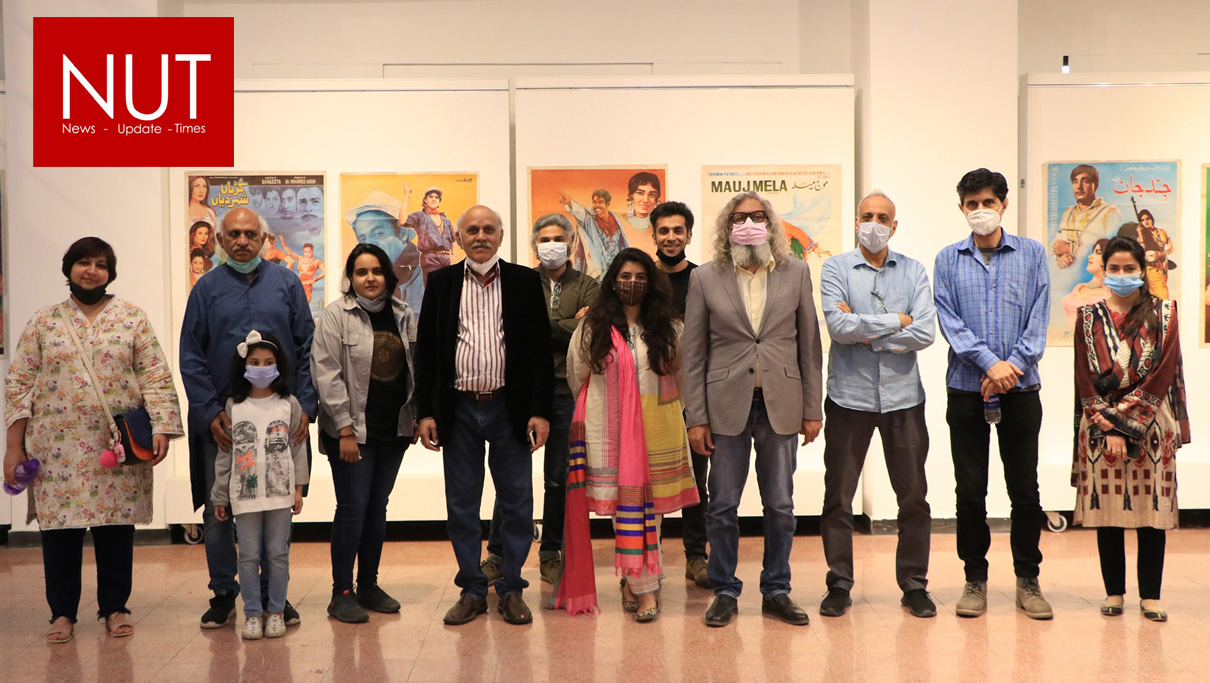
Lahore (Qasim Ali) In an effort to highlight the rich legacy and historical perspective of Pakistan film Industry, a unique exhibition comprising a series of Punjabi Film posters is getting concentration of the film & cinema students. The exhibition has been arranged by school of Culture and Language (SCL) and school of Digital and Cinematic Art (SDCA) at the main gallery of Institute of Art and Culture (IAC), Raiwind Road, Lahore.

IAC professor Zafar Iqbal inaugurated the exhibition, which consists of a variety of posters including handmade pieces and digital Punjabi Films posters produced from the era of 1935-2000 in the subcontinent. Posters put up and stuck to the walls of the cities in Ind-Pak region that invariably announced the arrival of a new film were a glimpse to the roots from where Punjabi cinema first started.

The exhibition has been curated by Ms. Kainat Thebo (lecturer, IAC). In the opening ceremony while talking to the viewers, she shared that the exhibition is a walk through time and history to realise that these posters are not just a piece of old papers but visuals that offer you a glimpse at the history of Punjabi films.

The exhibition not only included a display of posters but was started by a short documentary by Prof Qaisar Iqbal (Assistant Professor, IAC) that gave an overview of the history of Punjabi films in general.

The first Punjabi film screened on March 29th, 1935, titled “Ishq e Punjab/ Mirza Sahiban” was the first step to establishing a culture of modernity as well as showcasing our culture to the general public.

Thirty four (34) Punjabi films were produced from 1935 to 1947 in Kolkata, Bombay and Lahore. After partition, three thousand, five hundred and ninety two (3592) Punjabi films hit the cinema screens from 1948-2000 in Pakistan and India.

Prof Qaisar Iqbal was also invited to give a talk on Punjabi films and the language of Punjab and how its losing its identity overtime. Prof Qaiser Iqbal shared that the number of Punjabi films produced in Pakistan is second largest after Urdu and they have provided entertainment to a large population of the country from the decades. Filmmakers have used the soulful folk music tunes and poetry to enrich their productions and audiences have loved it also.

This was followed by a talk by Prof. Mushtaq Soofi (Professor, IAC) who gave an insight to the history and importance of Punjabi Language through the medium of film. Prof. Mushtaq Soofi said that film is among the most valuable medium of entertainment and communication and Punjabi films have played a significant role in projection of the culture of Punjab through quality films produced in earlier decades after creation of Pakistan.

Mr. Ali Ijaz (Lecturer, IAC) from the film department gave a talk on how visuals impact social, and political movements and could be a revolutionary tool in our society.

Students present in the exhibition took great interest in learning about the history of films and art of film posters making which now have been completely digitized after the evolution of modern technology.

Emirates SkyCargo marks one year of passenger freighter operations

Lahore (Muhammad Yasir) On Monday, 16 March 2020, Emirates flight EK 2503 took off from Dubai to Kuwait. Although operated on a Boeing 777-300ER passenger aircraft, EK 2503 carried no passengers but about 34 tonnes of bellyhold cargo that was urgently required in Kuwait.

It was the first time in the history of its operations that Emirates had operated a cargo only flight on a passenger aircraft. Coming just four days after COVID-19 had been declared a pandemic by the World Health Organisation (WHO), EK 2503 would be the first of more than 27,800 cargo flights to be operated by Emirates SkyCargo in the year that followed as the cargo carrier worked ceaselessly to keep communities across the world connected to the essential medical and food supplies they needed during the pandemic.

Nabil Sultan, Emirates Divisional Senior Vice President, Cargo said: “It has been exactly one year since what was considered impossible in the air cargo industry became not just a reality but a strong operational pillar for Emirates SkyCargo. Prior to the pandemic, nearly two thirds of our total cargo was transported in the bellyhold of our passenger flights. With increasing flight suspensions and restrictions on passenger travel imposed due to COVID-19 in early March 2020, we could foresee a situation where there would no longer be adequate cargo capacity available in the market to transport essential supplies.

“In order to bolster the cargo capacity offered by our 11 Boeing 777 freighters and make sure that we could meet the urgent demand for goods such as PPE, ventilators and other pharmaceutical goods and food supplies from across the world, we proactively made a radical and innovative plan to utilise our widebody passenger aircraft to operate cargo only flights. We trialled this passenger freighter concept with a flight to Kuwait on 16th March last year. Over the next few weeks, as regular passenger operations were completely suspended, we started increasing our passenger freighter flights to a point where we had close to 90 passenger aircraft being used for cargo operations.

“Our team worked tirelessly to flesh out a new business model from the ground up- seeking approvals from authorities, drawing up a new route network, drafting new operational and safety guidelines and speaking to our customers around the world – to make sure that as a socially responsible carrier, we were able to maintain essential supplies of cargo into markets and at the same time sustain exports around the world in challenging economic conditions.

“Our passenger freighter strategy has been the backbone of our operations during the pandemic transporting cargo to more than 125 destinations across six continents. It has showcased our resilience as a global facilitator of trade and supply chains. With resumption and growth in passenger operations, we have started gradually moving towards our traditional model but our passenger freighters continue to remain a strong component of the COVID-19 pandemic response.”

To meet the global demand for transport of PPE and essential supplies, Emirates SkyCargo followed up on the introduction of passenger freighter services with further innovations including the loading of cargo on passenger seats and in overhead bins inside the passenger cabin and introducing ‘mini freighters’ which were Boeing 777-300ER aircraft with seats removed from Economy Class to make more room for transporting cargo. Emirates SkyCargo currently has 16 Boeing 777-300ER mini-freighters for cargo operations.

Emirates SkyCargo has operated more than 27,800 cargo only flights on passenger aircraft during the last year. These flights have helped transport more than 100,000 tonnes of essential supplies including PPE, COVID-19 testing kits, ventilators, pharmaceuticals, vaccines and food. This is the equivalent of cargo carried over 1000 full flights on the Boeing 777 freighter aircraft.

Emirates SkyCargo’s flights helped maintain food security in a number of import reliant markets while also providing an income stream to communities dependent on agricultural exports. The air cargo carrier also operated a record number of charter flights using passenger aircraft exclusively to transport cargo.

Emirates SkyCargo has been leading the global air cargo industry’s response for the distribution of COVID-19 vaccines. The air cargo carrier has set up a dedicated GDP certified airside hub in Dubai for COVID-19 vaccines and has also partnered with leading Dubai based entities and with UNICEF for the rapid transport of COVID-19 vaccines to developing nations through Dubai. Emirates SkyCargo’s passenger freighters have also played a key role in the transport of COVID-19 vaccines.

Collaboration between Bank Alfalah and NS Cashpoint

Lahore (Muhammad Yasir) NS Cashpoint recently entered into a partnership with Bank Alfalah, one of the largest private banks in Pakistan, to better serve the Pakistan remittance corridor. The association with Bank Alfalah will allow both the entities to mutually benefit from each other’s brand value and service offerings in the APAC region, while harnessing the larger technological advancements of LuLu Financial Holdings, the parent company of NS Cashpoint. This partnership will enable affordable and faster cross-border transfers, thus driving greater value proposition for Pakistani expats in Malaysia. 

LuLu Financial Holdings has a stake of 70.83% in Malaysia’s NS Cashpoint, with NS Cashpoint being one of the leading Money Services providers in Malaysia offering cross-border remittances, currency exchange and banknotes services. Under this collaboration, Pakistani expats residing in Malaysia will be able to send remittances back home through the NS Cashpoint channel. Malaysia is home to a large number of Pakistani expats working blue- and white-collar jobs in the country, contributing significantly to Malaysia’s economy. This would encourage expats to use more legal channels for remittances, and provide them with a hassle-free transaction process for both senders and receivers. 

The partnership will also improve the speed of transfer, reliability, and cost of transfers from Malaysia to Pakistan.  Through this partnership, NS Cashpoint customers will get the benefit of sending remittances to Pakistan with ease and on a real-time basis through Bank Alfalah’s swift service, resulting in an increase in the overall volume of the transactions as well. Overseas Pakistanis residing in Malaysia will be able to use NS Cashpoint’s network to deposit money to any bank account in Pakistan with ease, remit cash over the counter payments, and pay utility and other bills in Pakistan. With this service, Bank Alfalah is reinforcing its commitment to facilitating overseas partners to enable smarter and faster ways of sending home remittances to Pakistan. 

“Bank Alfalah always wants to offer customers the best service which would meet their expectations, through strategic alliances with our overseas partners. With these type of alliances, we are always working to improve our service levels and expand our product offerings. Similarly, our alliance with NS Cashpoint allows us to serve even more overseas Pakistanis residing in Malaysia and their families back home in Pakistan, while promoting the goal of the State Bank of Pakistan to drive remittances through legal banking channels”. said, Mr. Faisal Rashid, Head Financial Institutions, Home Remittance & International Business, Bank Alfalah.

Atif Bajwa, President and CEO, Bank Alfalah stated, “Through this collaboration between Bank Alfalah and NS Cashpoint, we can now extend a more reliable and quicker way of remitting funds to Pakistan from our citizens residing in the APAC region. Creating safe and secure channels for remittances is essential to encourage and protect the flow of funds and therefore it is critical to partner with established and strong players like NS Cashpoint.” 

Adeeb Ahamed, Managing Director, LuLu Financial Holdings remarked on the agreement, “We are excited by the possibilities which the partnership between Bank Alfalah and NS Cashpoint makes available to millions of our customers in Malaysia. NS Cashpoint is a key payments brand in the country, serving several corridors dependent on the remittance economy. The partnership with Bank Alfalah will enable us to serve the Pakistan corridor better and harness the best of our global investments in technology and process expertise, to improve the quality of financial services offered in the region.” 

“The partnership between Bank Alfalah and NS Cashpoint offers a means to bring affordability and operational excellence to the gamut of cross-border financial services we provide to the Pakistan corridor. Our investments in digital innovation position us uniquely in the country’s payments ecosystem, and we hope to leverage a positive outcome from this partnership to better serve Pakistani expats in Malaysia’s urban, as well as remote and financially underserved locations”, stated Jacob Varghese, CEO, NS Cashpoint.