Huawei supporting ICT Ecosystem vital for digital transformation of Pakistani Youth

Lahore (Muhammad Yasir) Pakistan’s vision for a digitalized future is one that will enable the country to thrive through the immense potential of connectivity. A digital future will redefine societies, enabling growth and development, enhancing education and industry, and building new capacity for accelerating the economy.

Pakistan has been working tirelessly towards the development of its youth. This has been reflected by the adoption of the 2030 Sustainable Development Goals (SDGs), through which the country aims to activate a number of policies and actions that help empower and engage the youth for achieving the SDGs.

In line with this vision, Pakistan has launched initiatives, such as “Digital Pakistan”, that aim to empower the youth and enable them to become drivers of the country’s economic growth. Such initiatives are certainly establishing a strong base for the information and communications technology (ICT) ecosystem to thrive upon – but what we now need is to put our focus on Pakistan’s youth, to prepare them to take over and drive the country’s digital future.

Developing new skillsets for young people is something that is considered a priority in Pakistan. It also strengthens the ICT ecosystem, which will in turn contribute towards a stronger, digitally-driven economy – therefore investing in developing young ICT talents is a win-win situation that can only bring more benefits in the future, for everyone in Pakistan.

Numerous initiatives were organized in Pakistan, geared towards introducing young people to the ICT sector, educating them and enhancing their skills. These talent training programs include several ICT academies – including Huawei ICT Academies – and annual ICT competitions, amongst others.

Today there are several ICT academies across the country, launched in cooperation with renowned and prestigious universities. These academies operate in partnership with local educators and institutions, providing students with the opportunity to gain certification in some of the most relevant areas of ICT today. Courses at such institutions cover a wide range of technical fields, including routing and switching, storage, cloud, WLAN, cloud computing, big data, IoT, and artificial intelligence. To date, thousands of talented individuals have been trained and certified through these academies, providing them with the means to launch a career in the flourishing ICT industry. Even with the impact of COVID-19 and educational institutions closed as a result of the pandemic, students can access online training and certifications programs to continue learning.

In addition to that, annual ICT competitions have seen thousands of talented Pakistani college students participate in the past few years. These competitions aim to increase ICT knowledge, stimulate youths’ interest in learning and innovation capabilities, and improve their self-learning and problem-solving abilities.

With such immense potential amongst a young population, Pakistan is a goldmine of ICT talent. Harnessing this potential by making training and skills development opportunities accessible will ensure that the country has the best possible chance to not only realise its digitization ambitions, but to carry them forward for a brighter connected future for all.

ICT is playing a significant role in transforming economic activity. Considering its ongoing spread and importance for growth, developing ICT skills among the youth has major and tangible benefits on the advancement of digital economy.

Fostering an open, shared, ICT talent ecosystem benefits all parties in Pakistan. Consequently, cultivating ICT talent that meets industry requirements and treating them as the most important resource helps in driving the development of multiple sectors and industries.

Huawei is committed to sharing knowledge and technology experience and nurturing local ICT talents based on its talent cultivation standards gained from years of operations in the ICT industry in more than 170 countries. This has helped in developing the next generation of local ICT talent to boost the digital economy. Huawei’s talent ecosystem aims to bridge the digital divide, develop local ICT talent, and fulfill corporate social responsibilities. This comes in line with the company’s efforts to support governments in achieving their goals of creating the future ICT leaders who will responsible for achieving national targets and visions, and who will ultimately build a diversified and sustainable knowledge-based economy.

HEC and Huawei to Quadruple ICT Training Program

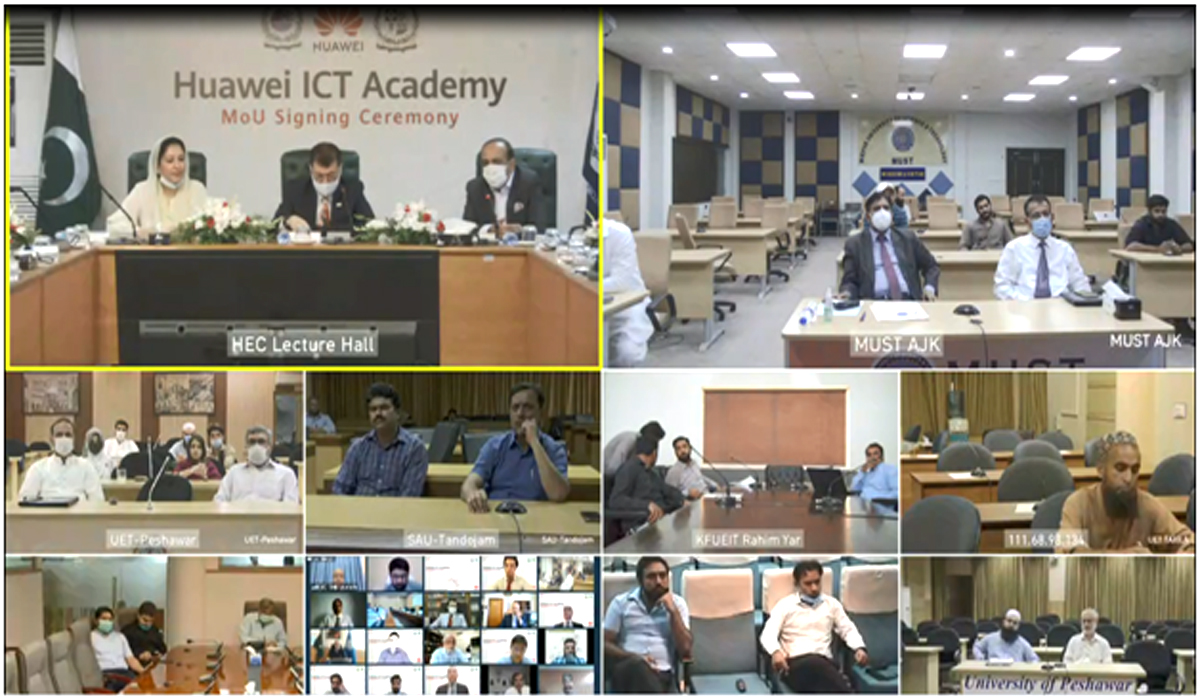
Lahore (Muhammad Yasir) The Huawei ICT Academy program will increase the number of training slots for Pakistani students four fold, from 800 per year to over 3,000 per year. A strategic Memorandum of Understanding (MoU) to this effect was signed between the Higher Education Commission (HEC) and Huawei Technologies Pakistan.

Under the MoU, Huawei ICT Academies will be established in eight new universities,which will join existing 15 academies by the end of 2020, bringing the total number of universities to 23. In addition, the Training Academies in 5 of the existing universities will be upgraded. The program will provide important support for the government’s Digital Pakistan initiative.

Chairman HEC Tariq Banuri graced the virtual signing ceremony as chief guest. The event was also attended by Parliamentary Secretary for Federal Ministry of Education and Professional TrainingMs. WajihaAkram, Executive Director HEC Dr. Fateh Marri, Vice President, Public Affairs and Communications, Huawei Middle East Li Xiangyu (Spacelee), and a large number of Vice Chancellors.

Addressing the ceremony, Chairman HEC said that the government is keen to bring about the technological transformation of the country, especially through the Digital Pakistan initiative, and the Huawei ICT Academy Programwill provide a great contribution to this objective.

He said that the program also supports HEC’scommitment to investing in the practical skills of Pakistani youth. He mentioned that HEC has launched the new undergraduate education policy,which includes a major focus on enhancing practical learning. “The new undergraduate program will offer students a menu of options to acquire practical skills, including through internships, entrepreneurial training, participation in social clubs, and sports. IT skills have become essential for future success in every field of endeavor.

The Chairman advised the Vice Chancellors to leverage the opportunities provided by the Huawei ICT Academy Program, not only to enhance students’ skills, but also to harness technologies in the universities operations, developing collaboration with other universities, and mobilizing revenues.

He concluded by saying that the MoU was a milestone in the longstanding relationship with Huawei, and is a reflection and reaffirmation of the deep-seated friendship between Pakistan and China. “Each step that we, the Pakistani and Chinese entities, take will further strengthen the Pakistan-China relations”.

Ms. Akramcongratulated the HEC and Huawei on taking forward the ICT Academy Program. She said the academia-enterprise cooperation projects, like the Huawei ICT Academy Program, will help build the ICT talent ecosystem in Pakistan.“I would like to thank Huawei technologies for their efforts and investment in Pakistan, and entrusting our youth, specifically those from the rural areas.”
Mr. Spacelee said Huawei has, for many years, been privileged to contribute to the development of Pakistan’s ICT ecosystem together with local partners like HEC. “We are excited to be working with HEC again to expand the opportunities available through the Huawei ICT Academy.” He appreciated HEC’s proactive leadership in the promotion of the digital economy in Pakistan.
Earlier, Dr. Marri shed light on the background of Huawei ICT Academy Program. He said that 800 students have been trained through the program on yearly basis, and that the MoU will provide an opportunity to increase the number to over 3,000 per year. He stated that HEC and Huawei have a shared motive to extend services and expertise in the field of IT and Communications.

The Huawei ICT Academy Program is a global initiative aimed at promotion of ICT technology skills. The program was launched by HEC and Huawei in 2017. It features industry-academia linkages and cooperation with universities in different countries for development, training and certification. It is based on Huawei’s advanced technologies in the ICT area and leading market solutions.

Twenty six universities submitted their proposals to the HEC for joining the program. Following an open and competitive selection process, eight universities were chosen to host the next set of ICT Academies. Theseare Mirpur University of Science and Technology, University of Central Punjab, Muhammad Nawaz Sharif Agricultural University, Khawaja Fareed UET, Usman Institute of Technology, Sindh Madressatul Islam University, UET Peshawar and the University of Peshawar. The five existing academies which will be upgraded, based on their past performance, are COMSATS University Islamabad, NUST, UET, NED University of Engineering and Technology, and Ghulam Ishaq Khan Institute (GIKI).