Coca-Cola Beverages Pakistan installs 30th water filtration in Pakistan

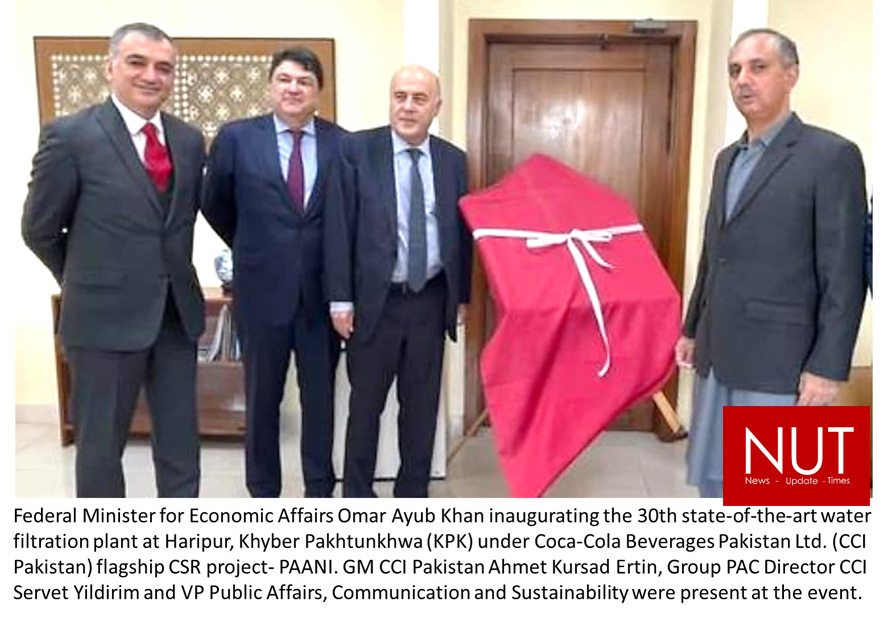
Lahore (Muhammad Yasir) Coca-Cola Beverages Pakistan Limited (CCI Pakistan) installed a state-of-the-art water filtration plant for the residents of Haripur, Khyber Pakhtunkhwa (KP) under its flagship CSR project- PAANI. The plant is situated close to the location of CCI Pakistan’s 7th production plant which is currently being constructed in Haripur district. The inauguration CCI’s 30th water filtration plant in Pakistan was virtually marked during a special ceremony hosted at the office of Mr. Omar Ayub Khan, the Federal Minister of Economic Affairs, in Islamabad on December 6, 2021. Also present at the ceremony were senior officials from CCI including Mr. Ahmet Kursad Ertin, General Manager at CCI Pakistan, Mr. Servet Yildirim, Group PAC Director at CCI, and other senior officials.

This water filtration plant has most modern ultrafiltration water treatment technology which has the capacity to supply up to 2,000 litres per hour of safe and clean drinking water at no cost to the local population. Following this new addition, CCI has now installed a total of 30 water filtration plants across Pakistan. CCI Pakistan’s flagship project PAANI is now serving over 1 million people across the country every day with clean drinking water, including in the areas of Lahore, Gujranwala, Faisalabad, Layyah, Tharparkar, Rawalpindi, and now in Haripur – protecting them from harmful waterborne diseases.

These waterborne diseases including typhoid, intestinal worms, diarrhoea, and gastroenteritis are very common and rampant across Pakistan. According to WWF, 20-40% of total hospital beds in Pakistan are mostly occupied by patients suffering from water borne diseases.

While commenting on this achievement, Ahmet Kursad Ertin, General Manager at CCI Pakistan said, “Owing to the lack of facilities in underprivileged communities of Pakistan, access to clean drinking water has always remained a priority for our sustainability interventions. Through our CSR project ‘PAANI’, CCI Pakistan remains committed in promoting access to safe and clean drinking water to the underprivileged communities of Pakistan. This filtration plant will not only provide safe and clean drinking water to thousands of families but will also protect them against harmful waterborne diseases.”

CCI is a multinational beverage company operating in 11 countries with 29 production plants. CCI Pakistan, a subsidiary of CCI, produces, distributes and sells sparkling and still beverages of The Coca-Cola Company in Pakistan. It currently serves a consumer base of 208 million with 6 productions plants and a workforce of 2,500 employees across Pakistan.


OPPO to launch innovative NPU and OPPO Air Glass on 2021 INNO Day

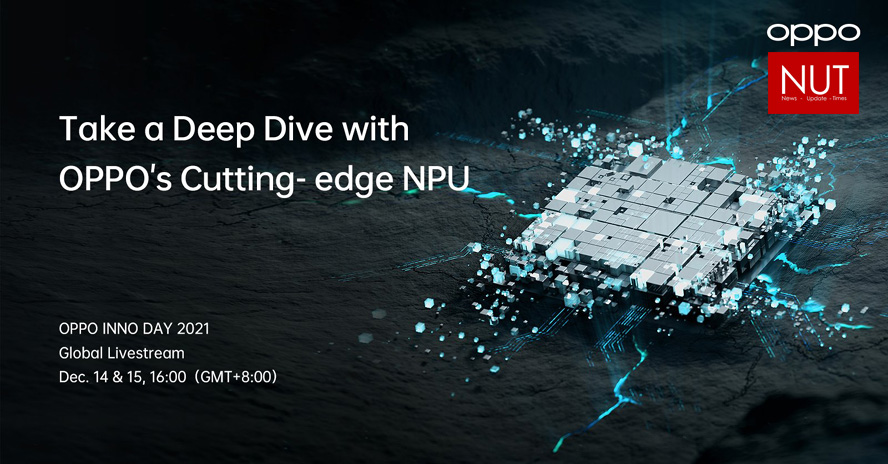
Lahore (Muhammad Yasir) One of the world’s leading tech brands OPPO will be introducing its latest, cutting-edge technologies and strategy plans at the upcoming OPPO INNO Day.

The brand will be announcing the launch of their first-ever Neural Processing Unit (NPU), along with several more technological breakthroughs. This year’s INNO Day is set to be one of the company’s biggest tech events and will highlight OPPO’s global plans to bring a new revolution of tech and smart-living.

The event is scheduled to take place online and offline on 14th and 15th December 2021, and will also serve as the debut of the highly-awaited OPPO Air Glass; the brand’s cutting-edge, new smart glasses.

The Founder and CEO of OPPO, Tony Chen will be delivering a keynote speech regarding the company’s updated corporate strategies and new directions in R&D. While the exciting launch of the NPU and OPPO Air Glass will be done by senior executives of the company.

OPPO INNO Day 2021 will also highlight some of the brand’s new technological breakthroughs, including OPPO’s retractable camera and digital human The brand will also showcase other innovations in the field of imaging, AI, AR and 5G.

OPPO INNO Day has been a groundbreaking day in the world of tech since it first began in 2019. The brand has consistently been introducing new concepts, products and innovations that are cutting-edge and push boundaries on a global level. 

During the first-ever OPPO INNO Day in 2019, the tech leaders announced the first generation of their AR Glass products, OPPO’s 5G CPE and OPPO Watch smartwatch series.

Last year, OPPO demonstrated three products: the OPPO X 2021 Rollable Concept Handset, AR Glass 2021, and CybeReal. This year, OPPO is set to take things to another level with the latest achievements and developments in technology and lifestyle.

OPPO has also created a virtual launch where users can use avatars to experience OPPO’s latest innovations and get an immersive and revolutionary online experience of the INNO Day on December 14th and 15th 2021.


Bank Alfalah Islamic and Grand City sign a Memorandum of Understanding to Promote Housing Finance in Pakistan

Karachi (Muhammad Yasir) Bank Alfalah Islamic, Pakistan’s premier financial institution providing Shariah Compliant Consumer financing products, has joined hands with Grand City Kharian – a project of Eurobiz Corporation, to facilitate customers in fulfilling their dream of buying their own house.

The signing ceremony took place at Grand City’s Office located in Phase 6, DHA, Lahore. Senior management of Bank Alfalah Islamic including, Talat Khurshid Mian – Retail Head, Muhamid Jamal Ansari – Head Consumer Finance, Muhammad Raza Sayeed – Sales Head Home Musharakah along with Syed Salman bin Waris Gillani – CEO Grand City and Sarfraz Ahmed – CFO – Grand City were present at the occasion.

Grand City Kharian is a project of Eurobiz Corporation, one of the leading companies in construction and development. The firm’s impressive portfolio includes residential complexes, a commercial business center, luxury apartments & townhomes. The current project is one of the most dynamic housing societies located on Main GT Road between Islamabad & Lahore.

The strategic partnership between Bank Alfalah Islamic and Grand City will cater to the evolving financial needs of mutual customers by enabling them to avail numerous benefits being offered under the Government’s Low Cost Housing Scheme. The combined expertise of both companies will help save time, reduce hassle, and create a seamless purchase & financing experience for customers.

On the occasion, Head of Consumer Finance of Bank Alfalah Islamic, Mr. Muhamid Jamal Ansari said “The alliance between both the parties will play a key role in materializing the vision of our customers of buying their dream house. Through this partnership, we will be providing an attractive Shariah Compliant House Financing package for Grand City & Bank Alfalah Islamic customers who want to enjoy international standards of infrastructure development with luxurious facilities. Customers will also have an option of financing under Low Cost Housing Scheme. We are offering vast range of products to our customers including purchase of a house, purchase of a plot and construction, as well as development on a plot already purchased by customer”.

Mr. Syed Salman bin Waris Gillani – CEO Grand City, while highlighting the unique features of the society, said, “Grand City has planned to offer best housing/apartment options for the customers with affordable price ranges. Alliance with Bank Alfalah Islamic will provide our customers with one of the best financing options in the market. Customers who are short of funds and need financing for construction of their houses can simply apply for construction financing from Bank Alfalah Islamic. The facility is not limited to construction; the customers who are interested in buying a house or a plot and constructing a house thereafter could also get benefits from Bank Alfalah Islamic”.


Pakistan’s cutting-edge technology can save $1bln in imports bill, $200mln fuel cost

Lahore (Muhammad Yasir)  Pakistani startup Energy and Automation (ENA) working under the umbrella of Jaffer Business System (JBS) has introduced an innovative new power backup storage technology named “ENARGEZE SUPERPOWER” that will prove to be a better replacement for (VRLA) dry batteries. Speaking to media, ENA’s Chief Executive Amir Salman, ENA’s Technical Director Osama Javeed and Director Faisal Murad highlighted that this new Super Cap technology life is 25 times more than VRLA dry battery, whereas it will play a vital role in making the entire process of work eco-friendly by saving $1billion in terms of cutting the level of import of low life batteries. ENA chief Executive Amir Salman told that ENA’s new initiative will set a benchmark among the competitors and will emerge as a new trendsetter in the world of tech-savvy by creating a pool of employment opportunities and facilitating huge growth. “We are using Super Capacitor for energy storage, which has more than 25 years of durability, instead of batteries having a life of 2 years or less. ENA has confidence and provides a 5 years warranty, Amir Salman added. While explaining the brass tacks of the new invention, ENA Technical Director Osama Javeed said that the Super Cap technology is 25 times better than the batteries commonly used in offices to backup. Outmoded batteries of 200amp capacity could be charged or discharged by up to 1000 times @ 50% DoD. However, the powerful new super capacitor could be “charged or discharged by up to 25,000 times @ 100% DoD.” VRLA dry battery takes 7 to 8 hours to recharge fully, while supercaps can be recharged within 1 hour. ENA Director Faisal Murad told journalists that in ENA our philosophy is to sell the solution, not the box (equipment), and make long term relationships with our customers. “With this new technological revolution, ENA business market will expand at a large scale with its commercially viable, plug-and-play replacement for chemical batteries as it will mostly benefit the Banking and Telecom sector,” Faisal Murad claimed. ENA’s director said that as the oil prices globally have risen to an alarming level and so the rates of PoL products in Pakistan, by adopting this modern technology multinational companies, banking sector, industries could save their fuel costing of running generator up to $200 million.


MMBL Partners with VRG

MMBL Partners with VRG to equip non-smartphone customers with self-service banking Via the USSD channel

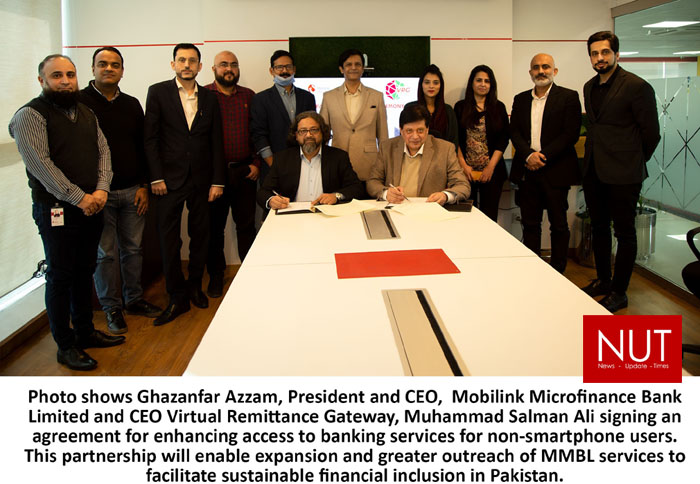
Karachi (Muhammad Yasir) Pakistan’s largest digital bank, Mobilink Microfinance Bank Limited (MMBL) has signed an agreement with Virtual Remittance Gateway (VRG), a veteran mobile financial services platform for banking customers, and Pakistan’s only commercial licensed Third-Party Service Provider (TPSP). Under this partnership, MMBL’s non-smartphone users will be able to use their bank accounts via Unstructured Supplementary Service Data (USSD) Channels. USSD is a widely accepted channel by customers for buying mobile bundles and checking prepaid balance amounts.

VRG, through its technical expertise, has embarked on enabling MMBL’s USSD channels, allowing MMBLs customers to use banking services 24/7 on their phones, that do not have 3G, 4G, WiFi, or Internet connections. With the help of USSD Channels, MMBL’s non-smartphone users will be able to check their bank balance, bank statement, transfer funds, pay utility bills, and recharge their mobile phone accounts without data or internet connection. The initiative will initially be piloted for a month’s period, followed by a commercial launch in January 2022.

Sharing his thoughts about the partnership, Ghazanfar Azzam, President & CEO MMBL said, “We are committed to expanding our financial services to a wider pool of customers by targeting the underserved segments of the society. Over the years, MMBL has successfully been able to reach millions of customers across Pakistan through its wide array of innovative products and services specifically tailored to promote financial inclusion for all. With VRG’s partnership, MMBL plans to revolutionize Pakistan’s banking sector by bridging the financial gap and eradicating all barriers to access digital financial services.”

Chief Finance & Digital Officer MMBL, Sardar Mohammad Abubakr said, “MMBL is dedicated to uplift the unbanked and underserved segments, particularly SMEs and women-led businesses, by providing them access to financial services through its expansive digital financial ecosystem. Through this partnership, we strive to accelerate further growth by merging USSD Channels with our tailored products and services that will not only enable individuals at a wider scale but will give them a chance to contribute positively to Pakistan’s digital financial ecosystem as well.”

Speaking at the occasion, Muhammad Salman Ali, CEO VRG said, “Customer centricity is at the heart of banking and this collaboration is a significant step towards digital banking making its impact bigger on customer experience across business segments. Providing Unified USSD service to access banking will not only enhance the customer experience but also augment MMBL’s digital footprint to reach customers who were previously out of the digital banking net.”

Mobilink Microfinance Bank is committed to leading digital banking initiatives across the country. The bank is promoting financial inclusion by providing innovative, convenient, and accessible digital financial solutions to the masses.

TVET SSP launches initiative to assist expats’ socio-economic settling

Lahore (Muhammad Yasir) In order to consolidate the Punjab government’s endeavours to ensure sustainable economic development, the TVET Sector Support Programme (SSP) has launched a special initiative to assist 15,000 local individuals including the Pakistanis returning from foreign countries to gain socio-economic settling.

Under this formally launched initiative ‘Reintegration of Returnees in Pakistan’ these 15,000 individuals will include 6,500 returnees from Germany, Europe and Gulf Cooperation Council (GCC) countries through various support measures including career and entrepreneurship advisory services, Competency-based Training & Assessments (CBT&A), recognition of prior learning, and employment promotion.

The TVET SSP is funded by the European Union, Germany and the Norwegian Embassy. The reintegration measures for resettlement of Pakistanis returning voluntarily from GCC countries, Europe and Germany are supported by the German Federal Ministry for Economic Cooperation and Development (BMZ).

The programme is implemented by the Deutsche Gesellschaft für Internationale Zusammenarbeit (GIZ) GmbH in partnership with the National Vocational and Technical Training Commission (NAVTTC)in close collaboration with the provincial Technical Education and Vocational Training Authorities (TEVTAs) and several not-for-profit, public and private sector organizations.

The ceremony also saw the participation from representatives of various stakeholders of the TVET sector including the Punjab Vocational Training Council (PVTC), the Women Chamber of Commerce and Industry (Lahore Division), the Punjab Skills Development Fund (PSDF), and World Wide Fund Pakistan (WWF).

The ‘Reintegration of Returnees’ initiative will support Pakistani returnees and the local communities (non-returnees) by offering them quick and effective start-up opportunities, especially in Punjab, as this region is most affected by return migration.

At the occasion, the TVET SSP and the Punjab Technical Education and Vocational Training Authority (TEVTA) signed a partnership agreement.
Chairperson Punjab TEVTA Ali Salman Siddique, Director General Punjab National Vocational and Technical Testing Commission (NAVTTC) Mujeeb Ur Rehman, and Head of TVET SSP, GIZ Pakistan, Ms. Iris Cordelia Rotzoll were present at the signing ceremony. Ali Salman Siddique and Iris Cordelia Rotzoll signed the agreement.

The initial partnership will offer reintegration assistance to 425 returnees and locals through CBT&A and Recognition of Prior Learning. Additionally, 200 toolkits will be provided as in-kind support while training institutes in Punjab will furthermore be benefitting from labs upgraded with training equipment.

Speaking at the ceremony, Ali Salman Siddique expressed satisfaction to join this progressive initiative. He said, “It is of utmost importance to provide suitable training and skills development opportunities to the returnees, and I believe, such partnerships equip us to play our part in the process. Punjab TEVTA has been working in close coordination with the TVET SSP for a decade now and these new collaborations show our confidence in each other. Many workers from Punjab move to GCC countries in search of better work opportunities and when they return, they at times struggle a bit. Punjab TEVTA hopes to sustain this partnership and help the returning migrants in Punjab.”

In her remarks, Iris Cordelia Rotzoll also believed this partnership was an important step towards the success of this new initiative. “The German Development Cooperation considers the TVET sector as a crucial factor in the socio-economic development of Pakistan. The addition of the reintegration component is an important step. I believe returnees will benefit from it immensely” she said.

Infinix to introduce Limited time discount offer on Zero X and HOT 11 series in regards for New Year!

Lahore (Muhammad Yasir Following the massive success of its latest series of smartphone in Pakistan, Infinix is bringing the biggest, most exciting treat for its valued users ahead for the New Year. Infinix ZERO X and HOT 11 series will now be available on discounted prices at both online and offline stores nationwide. The sale has already gone live on Infinix’s official ecommerce partner Daraz.pk and also on Xpark where ZERO X Pro, ZERO X Neo, HOT 11S, HOT 11, HOT 11 Play and HOT 10 are available on slashed prices.

Below is a snapshot of the discounted prices:

Handset Model Original Price Discounted Price
Infinix ZERO X Pro PKR 51,999 PKR 49,999
Infinix ZERO X Neo PKR 35,999 PKR 33,999
Infinix HOT 11 PKR 24,999 PKR 22,999
Infinix HOT 11 S PKR 26,999 PKR 24,999
Infinix HOT 10 Play PKR 21,999 PKR 20,000

The ZERO X and HOT 11 series have already garnered much praise since their introduction in the Pakistani market. Following are some excellent features these phones offer.

Infinix ZERO X series

Infinix ZERO X Pro features a 108 MP Moonshot camera with a 60X periscopic zoom, Optical Image Stabilization (OIS) and Electronic Image Stabilization (EIS); ZERO X Pro can shoot everything easily no matter how far it is. While on the other hand Infinix ZERO X Neo comes with a MediaTek Helio G95 ultra game-play processor for a power packed user experience altogether.

Infinix HOT 11 series

Infinix HOT 11 is super-fast, with the MediaTek Helio G70 core processor and a 6.6” FHD+ color-accurate display. Infinix HOT 11 S includes an additional 50MP f/1.6 wide aperture camera and 5200mAh long-lasting battery, while the HOT 10  Play features a 6000mAh power marathon battery enough to last all day long.

Do not miss the chances to avail the fabulous discount this December on tailored Infinix devices, and add delight to this festive season!


Workshop held: Financial Inclusion Gender Data in Pakistan: Today and Tomorrow

Women’s access to banking services in Pakistan increased by 29% from 2008 to 2020, gender gap more than doubled during the same time period

Lahore (Muhammad Yasir)  An online workshop titled, ‘Financial Inclusion Gender Data in Pakistan: Today and Tomorrow’ was held under a partnership titled ‘Women’s Financial Inclusion Data’ (WFID) a key platform engaged in increasing awareness about the importance of sex-dis aggregated financial services data and catalyzing action to increase women’s financial inclusion. WFID partners include the Alliance for Financial Inclusion (AFI), Data2X, the Financial Alliance for Women, the Inter-American Development Bank, IDB Invest, the International Finance Corporation, the International Monetary Fund (IMF), the World Bank Group, the Organisation for Economic Cooperation and Development (OECD), and the United Nations Capital Development Fund (UNCDF). In Pakistan, Karandaaz joined hands with this group to organize this workshop and to take forward the agenda of ‘Gender Data for Financial Inclusion’. During the workshop, the findings of a recent study conducted by ConsumerCentrix (CCX), a Geneva-based strategy consulting firm for AFI, to map national ecosystem related to gender data on financial inclusion were also shared.

Karandaaz helped to co-ordinate the data collection and interviews with different stakeholders for this study. AFI has an ongoing collaboration with the State Bank of Pakistan (SBP) for the Banking on Equality Policy. The workshop was attended by Sima Kamil, Deputy Governor (Financial Inclusion, Digital Financial Services & IT) SBP; Dr. Shamshad Akhtar, Chairperson Karandaaz; and Inez Murray, CEO Financial Alliance for Women. Also in attendance were Anna Gincherman, a partner at ConsumerCentrix (CCX); Rebecca Ruf leads peer learning, knowledge production and data analytics programs for the Financial Alliance for Women; and Mehr Shah, Director Knowledge Management and Communications at Karandaaz Pakistan.

The workshop underscored the importance of supply side data on women’s access and use of financial services, including volumes lent to their businesses, in order to both drive more financial services providers to design for the women of Pakistan and for policy makers to create a more supportive enabling environment for commercial engagement.

Dr. Shamshad Akhtar, Chairperson Karandaaz while addressing the workshop said, “The case for including women in the formal financial system is not based on a social or moral argument alone but also on the fact that women present a viable business proposition for service providers. According to a Boston Consulting Group study, women control more than USD 20 trillion in consumer spending globally and are increasingly becoming a major force as entrepreneurs running small and medium enterprises. There is an unmet global credit demand of nearly USD 1.7 trillion amongst women-owned SME businesses. Women are also more prudent borrowers compared to men. The Financial Alliance for Women estimated that, in 2019, the non-performing loans within its members’ portfolios was more than 50% higher for men than women.”

Sima Kamil, Deputy Governor (Financial Inclusion, Digital Financial Services & IT) SBP in her remarks said, “There are 82 million unique bank accounts in Pakistan as of December 2020, out of which 21 million belong to women. This represents 33% of adult women having a bank account. Women’s financial inclusion has been one of the top priorities of the National Financial Inclusion Strategy (NFIS) and was reinforced by the newly developed Banking on Equality policy, which was launched on September 17, 2021, and has introduced measures for embedding a cross cutting gender lens in policies and practices of financial institutions.

These include promotion of gender diversity in financial institutions and their access points, introduction of women centric products and targeted outreach, establishment of women champions at all touch points, and formation of a policy forum on gender and finance. One other important pillar of this policy is collection of robust gender-disaggregated data and setting targets for financial institutions. I am glad that this study will supplement SBP’s fundamental focus on gender disaggregated data, emphasized under our Banking on Equality policy.”

Speaking to the workshop participants, Inez Murray, CEO Financial Alliance for Women said, “Access to a bank account in Pakistan has grown from 4% of women in 2008 to 18% in 2020. While this is a very positive trajectory, it means that 82% of women in Pakistan still do not have access to a formal bank account. The gender gap in access to financial services has widened over this period. Women’s financial inclusion is well established globally to be one of the most powerful levers for bringing households out of poverty.

PAS elects its new Executive Council and Office Bearers

Karachi (Muhammad Yasir) Pakistan Advertisers Society (PAS) held its 24th Annual General Body Meeting on Friday, 3rd of December in Karachi. The AGM was attended by all the major advertisers of Pakistan. The Executive Director of PAS, Mr. Qamar Abbas, presented key initiatives of 2021 along with some of the important industry issues. The agenda for 2022 was also proposed to the members. This was followed by a presentation on the Effie Awards Pakistan by Afsheen Rizavi, project head and General Manager, PAS.

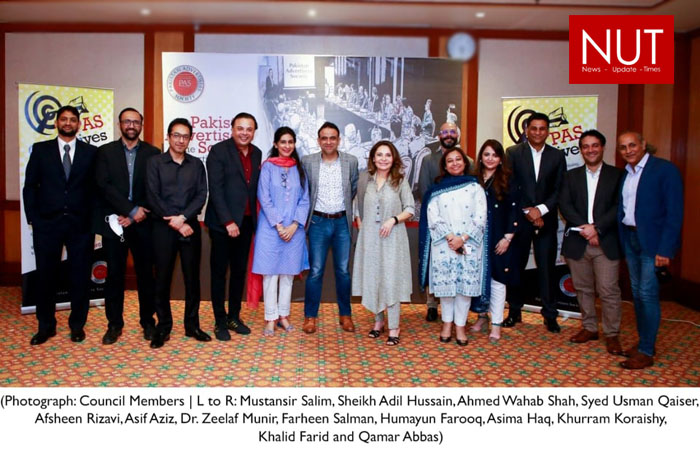
The AGM also marked the end of two-year tenure of the current Council and the Office Bearers. The elections for the new council were also part of the proceedings. The newly elected Council comprises of 14 members. Dr. Zeelaf Munir, CEO and Managing Director of English Biscuit Manufacturers was elected as the Chairperson of the Society. She is the first woman to hold this position.

She said “I am honoured and proud to be nominated as the first woman Chair of the Society. I strongly believe in the cause and the role marketing and marketers can play for a sustainable future that is diverse, equitable and inclusive, which will be our area of focus in 2022 and onwards along with some meaningful initiatives for the fraternity. I thank all my council members for putting their trust and faith in my leadership and hope to deliver on their expectations to the best of my ability”.

Khalid Farid, CEO Gillette/CCO P&G was elected as the Vice Chair and Farheen Salman, CEO, Ekaterra – A Unilever Tea Company was nominated as the General Secretary of the Society. In addition, for specific initiatives, Asif Aziz, Chief Commercial Officer of Jazz and the outgoing Chairman of PAS, was nominated as the Chair of the Govt. Relations Committee, while Faisal Rana, Director Marketing and Communication, Nestle Pakistan was nominated as the Chair of the newly formed Regional Committee.

Other representative members of the newly elected Executive Council include Ahmed Wahab Shah -The Coca Cola Co., Asiam Haq – Unilever Pakistan, Hassaan Serwani-PEL, Humayun Farooq-Reckitt Benckiser, Humayun Shaikh – Shan Foods, Khurram Koraishy – AlKaram Studio, Nauman Khan – Dabur, Sheikh Adil Hussain-Tapal Tea and Syed Usman Qaiser – Jubilee Life Insurance. The new council will start its term from 1st of January 2022. The AGM was concluded on a high note with Asif Aziz handing the Chair to Dr. Zeelaf Munir and thanking all the members of the Society and specially the Council for supporting him during his tenure.

He said “I would like to urge all the companies that are part of the PAS fraternity to keep lending their support to this industry body that we have together brought this far. For the companies who are yet to come onboard with us, I would say that the time is now for you to join forces and play your part in making Pakistani brands and communication stand out and shine across the globe.”

Robust and resilient public financial management essential to manage present and future risks

Lahore (Muhammad Yasir)

Achieving the UN Sustainable Development Goals (UN SDGs) depends on the effectiveness of governments and their management of the public purse.

There are important lessons to learn from the Covid-19 crisis for governments and the resilience of their approach to public financial management (PFM), says ACCA (the Association of Chartered Certified Accountants) in a new report Rethinking public financial management. Launched to coincide with ACCA’s annual Virtual Public Sector Conference (1 – 2 December 2021), the report explains that a government’s ability to do anything depends on the strength of its PFM system – how it prepares budgets, obtains financing, spends money, and keeps its accounts. And to meet ongoing challenges such as Covid-19 and meeting the UN SDGs, it’s essential that governments have the right, skilled people in place to do this very necessary work.

Alex Metcalfe, ACCA’s head of public sector and co-author of the report explains: ‘It’s a significant risk to a government’s success if it doesn’t have the right number and quality of public finance professionals. To benefit from their improved PFM systems, governments may need to make a significant and sustained investment in their PFM systems, and also in competent public finance professionals who will advise on future decisions.’ Gary Bandy, a PFM specialist and co-author adds: ‘Financial management is critical to the delivery of public services and sustainability of economies. The pandemic has led to lessons for governments about what did and what didn’t work as well as expected.

We offer recommendations for a way ahead as it would be a real opportunity missed to learn from the pandemic if governments returned to a pre-Covid status quo for their PFM arrangements.’ The report sought views of 1,500 ACCA members and affiliates globally, asking them how they felt governments responded to the Covid-19 pandemic and how PFM must now evolve to deal with future crises. Respondents also said that the four most commonly faced challenges by governments were: · responding to the financial needs of individuals and businesses (45%) · being able to transition to remote working (42%) · having the necessary technological/ digital capacity (42%) · maintaining accountability and transparency of government spending (41%) Respondents in North America, the Middle East and Western Europe were much more positive about the effectiveness of their public sector institutions than respondents from other regions. Looking at sectors, public sector respondents – 62% – were much more likely than those in the private or not-for-profit sectors (42% and 37%) to agree that their government had made an effective response to the pandemic. Respondents offered three main areas for development of PFM: · improving transparency and accountability of government spending · better prioritisation of resource allocation, and · intensifying the focus on risk management Relatively few respondents included tracking climate change as one of the top priorities for development, but governments must rebuild and manage the public finances in a way that contributes to the climate challenge. Alex Metcalfe concludes: ‘There isn’t a one size all approach tackling the challenges, and each government will have its own fiscal and economic issues to solve.

The path to return to the new normal will be different because each government is in a different place as a result of its Covid-19 responses. The long-term implications of Covid-19 spending – significantly increased government debt or other liabilities in most cases – means difficult policy choices will have to be made.’