Tech Valley Pakistan and Karachi Police Join Forces

Tech Valley Pakistan and Karachi Police Join Forces to Propel Policing into the Digital Age with Google Workspace.

Karachi (Muhammad Yasir)

Karachi Police and Tech Valley Pakistan, a Google Workspace and Google for Education Partner in Pakistan are proud to announce a transformative collaboration aimed at revolutionizing law enforcement through digital innovation. This visionary initiative promises to streamline policing processes, resulting in more effective law enforcement and enhanced public safety.

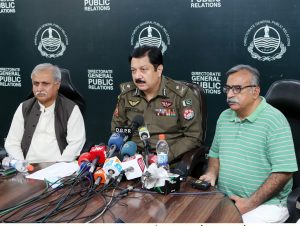
An MOU was signed between Mr. Imran Yaqub, DIG Administration, Karachi Police with Mr. Umar Farooq, CEO Tech Valley Pakistan, in the presence of Regional head of Google for Education, Australia, New Zealand and Pakistan, Mr. Paul Hutchings and Google for Education Consultant for Asia Pacific Region, Mr. Harris Sufian.

Mr. Imran Yaqub, DIG Administration Karachi Police said, “The Karachi Police is committed to enhancing its operational capabilities through technology, and the adoption of Google Workspace is a pivotal step towards achieving this goal. Under this partnership, every Karachi Police official will receive a secure digital identity, ensuring streamlined access to critical information.”

Mr. Umar Farooq, CEO of Tech Valley, emphasized, “This partnership marks a significant step in our mission to leverage technology for societal betterment. Together with Google tools, we are poised to bring innovative solutions to the forefront, making our communities safer, more efficient, and more connected.”

In addition to that, Google for Education tools will be leveraged in Karachi Police Training Department coupled with the power of Chromebooks which are based on Google operating system that is speedy, smart and secure. To kick start this journey, Tech Valley will be donating 10 Chromebooks to the training department to help them explore how these devices can be helpful across the whole police department.

Mr. Paul Hutchings, Regional Head of Google for Education for New Zealand, Australia, and Pakistan, shared his enthusiasm, stating, “We are genuinely excited to be a part of this journey, and we are eagerly looking forward to exploring new avenues of collaboration and partnership.”

The partnership between Tech Valley Pakistan, Karachi Police, and Google Workspace marks a significant milestone in the modernization of law enforcement processes. By embracing digital transformation and utilizing the robust security features of Google Workspace, the Karachi Police is poised to enhance operational efficiency and better serve the public.


Information Technology Department, Gilgit Baltistan

Pakistan (Muhammad Yasir)

Skardu, Pakistan – The Information Technology Department and Circle Women Association in collaboration with the Government of Gilgit-Baltistan organized a four-day training program titled “Nano Influencer Academy For Women ” to provide employment opportunities to young women in Gilgit-Baltistan through digital literacy and creative skills.

The provincial minister for information technology, Tehreen Zaman, attended the event as the chief guest. She addressed the participants and said that the purpose of this four-day training session is to highlight the hidden talents and skills of young women in Gilgit-Baltistan and provide them with employment opportunities through digital media platforms from home. She also said that the women of Gilgit-Baltistan are talented and that their business skills need to be highlighted. She expressed hope that the young women participating in the training program will benefit from it and be able to use their skills to generate income from home.

The CEO of Circle Women Association, Sadaffe Abid, said that her organization is a tech-enabled non-profit organization that aims to empower women through digital literacy and business skills. She said that the training program is designed to teach young women how to use digital media platforms to generate income.

The training program was attended by government officials, social media influencers, and other stakeholders. A memorandum of understanding was also signed between the Information Technology Department and Circle Women Association to further collaborate on initiatives to empower women in Gilgit-Baltistan.

Tracing the footprints of Hakara civilization

Lahore (Qasim Ali)
In an effort to spread awareness about one of the oldest and ancient Hakra culture, Thaap hosted an enlightening information session (54th Thaap Talk), in which eminent archaeologist Professor Dr. Mohammad Rafique Mughal presented insightful details of Hakra culture and its connection with the Harappan or Indus Civilization. The talk was attended by a large number of archaeology students, researchers, historians, and academicians.
Dr. Rafique Mughal presented a comprehensive introduction to the Hakra cultural phase and its characteristics. He said that initial footprints of Hakra marking the first stage of the Indus civilization were discovered at Jalilpur, Multan district in 1971. Further survey and research revealed more sites details of Hakra cultural phase which were found to be wide spread before the emergence of Harappa and Mohenjo-daro.
Situated all the banks of (now dry) Hakra River and beyond in the Indian territory of north Rajasthan and east Punjab, the Hakra settlements show a distinct tradition and life from the nomadic to permanent settlements. Its cultural components gradually merged with the well known Kot Dijian culture now recognised as Early Harappan culture of the Greater Indus valley. The great cities of the Harappan /Indus Civilization represent its climax.
Archaeologists on both sides of international borders have revealed that Hakra culture had strong footprints in Cholistan and surrounding areas. Its settlements have been found at Sheri Khan Tarakai in KPK, northern Punjab, Harappa in Pakistan and across the border at Girawad and Farmana in India. With the passage of time, Hakra culture evolved to its mature or fully organised stage. It had even developed trade links with other regions as well. Production, selling, and exchange of various items were routine features. Dr. Rafique also explained notable characteristics of Hakra cultural phase, life patterns of its inhabitants, folk culture, birds, animals, ceramics, and artefacts.
During the talk, Dr. Mughal mentioned that the journal, Pakistan Archaeology, volume 29 contains a great deal of information on the monuments and ancient sites including Hakra sites which was documented during another survey of the Punjab conducted by the Pakistani archaeologists. He urged that educational institutions should expose young archaeology students to field work like those of Hazara University so that more information on Hakra and early civilization could be documented.
He also answered various questions asked by the scholars and students regarding evolution of Hakra culture. Dr. Rafique Mughal invited students to join Madam Sajida Haider Vandal for few weeks in Cholistan to do field research work. He suggested that universities should devise specific training courses for the students of archaeology and priority should be given to the field work beside theoretical study.
Professor Pervaiz Vandal thanked the Dr. Rafique Mughal at the end of indepth and scholarly talk. He gave reference to a folk song of Cholistan ” Mola wal wasa day Hakra” (O God make Hakra inhabitable again). He said that there is a dire need to further research and more excavation to gain a full picture of Hakra cultural phase of the Harappan Civilization and to present it the world.

PSDF aligns its courses and program with exporting sectors need

Pakistan (Muhammad Yasir)

Founding Chairman of Board of Director of Punjab Skills Development Fund (PSDF) Dr Ijaz Nabi said that the Fund over achieved all of its targets which is success story and setting up new millstone of Section 40 companies in Pakistan. Addressing a gathering of stakeholders at the Annual Dinner of the Fund, Dr Nabi said that the Gender Parity target is also over achieved while half of the Board members are now women and alongside the Chairperson. Further, now the PSDF shall focus on a self-generated budget for which it has to provide skill training courses for the private sector. “When PSDF was launched it was solely dependent on Government of Punjab and DFID fundings, but now it’s one third funds are generated other than the government”, he said suggesting that it shall be 100 percent in future. Sharing the past, Dr Nabi said that the PSDF over a decade ago was launched with primary focus of poverty alleviation from the least developed districts of the Punjab.

Later, the courses and programs were scaled-up and launched across the province with growth orientation focus. Now the PSDF shall focus towards the exports-oriented courses and training. Justifying the need of exports-oriented courses and training, Dr Nabi mentioned that Pakistan annual remittances are around USD36 billion which is almost 10 percent of the GDP. Pakistan’s export to GDP ratio is now the lowest in the South Asian countries which was the highest 15 years ago. Now the country needs to be focused towards exports while the industry needs trained and skilled workforce to increase the exports, he added. He believed that the private sector will invest in the PSDF in the form of paid courses and training when the PSDF will be able to produce courses according to their needs.

Speaking on the occasion, Chief Operating Officer of the PSDF Ali Akbar Bosan said it was the support and directions of the Board which resulted in development, expansion and sustainability of the Fund. The PSDF was evolved for the poor and vulnerable segment of the society and remained focused on its objective of creation.

The PSDF followed the vision of the Board, the PSDF outsourced the non-core functions including the monitoring of the programs, payrolls and others. Besides, it also focused on adoption of technology and outsourced the complete process of its procurement with technology adoption. This all happened with the technology adoption and system has given leverage which resulted in managing multiple sources of fundings with a number of projects. Currently, 40 percent funding of the programs and course is coming from other funds including Export Development Fund, World Bank, and Tribal Area Funding, he said, adding that the technology adoption has also enabled the PSDF to work with limited offices and workforce efficiently. Founding CEO of the PSDF Ali Sarfraz in his video message said that starting from humble beginning from 4 districts, the PSDF expanded to across Pakistan.

Adoption of technology and public private partnership enabled it to achieve goal of youth skill development fund without investing in infrastructure by govt thus saving billion of rupees. Immediate past CEO of PSDF, Jawad Khan in his message said that AI and digital economy is the future thus there is need to adopt these technologies at the earliest and youth is skilled in future technologies

Eminent pre-partition Sikh artist Sobha Singh remembered in Lahore.

Lahore (Qasim Ali)
Prominent Punjabi artist Sobha Singh, renowned for his evergreen creative works including the painting of punjabi folklore characters “Sohni-Mahiwal”, “Heer Ranjha “,”Sassi Punnu”, etc was remembered in Lahore. In an exclusive literary evening held at Thaap secretariat, speakers shed light on versatile artist’s rich artistic legacy, including paintings, sculptures, and poetry, as well. 
Professor Dr Sajida Haider Vandal former principal National College of Arts while recalling the Sobha Singh’s  association with Lahore shared that Sobha Singh stayed at Lahore from 1926 to 1931 and then 1944 to 1947.His studio Eco School of Art was situated on Brandreth road adjoining railway station, later he shifted to Anarkali Bazar. Sobha Singh’s works in Lahore include Baba Sheikh Farid, Guru Nanak, Guru Gobind Singh, Mata ji with Sahibzade, Neotian Di Oat Guru Amar Das Ji, Pehli Udasi, The Window, Mirza Sahiban and Shri Guru Teg Bahadur Sahib de Vachitar Kautak etc. These were published as posters from Premtone Press.
During the evening, “Sobha Singh Artist: Life and Legacy” a book authored by artist’s grandson Dr Hirday Paul Singh, highlighting the life journey of legend artists, was also launched. Based on information available in the artist’s diaries, the book is divided into two parts. The first part takes an in-depth look at his childhood, his struggle, and awakening. The search of a wider canvas took him to Amritsar and Delhi, where his famous “Sohni-Mahiwal” was painted taking him to great artistic heights. Part two of the book looks at Sobha Singh’s major paintings and other creative endeavors, including sculptures and poetry. 
Speakers revealed that Sobha Singh, a celebrated artist, philosopher, scholar, was not in favour of painting human misery and suffering. He felt that an artist should paint only beautiful things even at the risk of being rejected. Sobha Singh left behind a rich creative legacy that still inspires aspiring artists, historians, and punjabi diaspora around the globe. Sobha Singh breathed his last on August 22nd 1986 in Chandigarh, his works are a  source of inspiration and epitome of Punjabi culture and history.His art gallery and museum is situated in Andretta in Indian hill state Himachal Pradesh and visited by thousands of art lovers and tourists from all over the world.
Professor Dr  Sajida Haider Vandal also presented the copy of the book to distinguished research scholar Dr. Kanwal Khalid for research work. Another copy will be presented to the library of Oriental College Punjab University to be used as a reference book by the students for their thesis and projects.These books were exclusively sent by notable Canadian Punjabi Scholar Sardar Jaiteg Singh Anant from Hardarshan memorial international trust Canada, who is actively involved in preserving the history of Punjab and working as a bridge to bring the literacy circles of both sides of the Punjab together. 

Tracing Home workers, Improving Transparency and working conditions

Tracing Home workers, Improving Transparency and working conditions of women workers in the Garment Textile and Apparel supply chains.

Lahore (Muhammad Yasir) With the Home base workers legislation enactment and inclusion of HBWs in the Labour workforce Pakistan leads the way in South Asia in legislation for homeworkers. The promising policy environment has the potential to put Pakistan in a strong position as trade with the EU – and other OECD countries – increasingly becomes subject to business and human rights compliance standards. This was shared by Ume Laila, Executive Director, Home Net Pakistan in a policy dialogue held today in Lahore. The dialogue aimed at discussing the major challenges in mainstreaming the home base workers from the informal economy in the major labour dialogue. There are initiatives taken by the GoP for recognition of the HBWs as a work category. However there are still major hurdles in the implementation of the Punjab HBWs Act 2023. Amidst the changing and challenging scenario of politics, labour situation, global markets; women in informality belonging to home base sector remain vulnerable with uncertainty and lack of clarity of the their roles and position within the existing labour market. Though not yet at implementation stage, the Homebased Workers Act 2018 of Sindh province, Punjab (2023), Baluchistan (2022) and Khyber Pakhutwah (2021), provide crucial frameworks within which homebased workers are in line to be recognized and access fairer treatment under law stressed Ume Laila.

Ume Laila said that HomeNet Pakistan under the initiative of “Tracing Home workers, Improving Transparency and working conditions of women workers in the Garment Textile and Apparel supply chains”; intends to follow up on the dialogue for creating spaces for the women in the garment and textile as informal workers. Through larger sensitization and capacity building of the home workers and the relevant stakeholders around presence of home workers within supply chains and initiate dialogue between relevant stakeholders. It is envisioned that the dialogue would provide a platform to ensure collective actions to further ensure inclusion and protection of Home workers across supply chain.

Rao Zahid, Deputy Secretary LHRD shared the main clauses of the HBWs Act, the fifth approved law off the year 2023. He shared the definitions in the law e.g HomeBased Worker, contractor,Wages, Worker Establishment of welfare Fund with the seed money by GoP. Which will utilize for the cash benefit of HBWs and their skill development.

  1. Ikram from Employers Federation of Pakistan said that Given this, it is now even more important that EU-based brands operating in Pakistan take steps to gain better visibility on their supply chains and understand impacts they are having, as buyers, on their suppliers’ capacity to support the most vulnerable workers. Hiddenness itself drives vulnerability as brands are often not aware of these workers vital contribution to production processes and not able to include them as part of regular audits. At the same time, it is well known that buyers’ requirements often mean that a flexible workforce – including homeworkers and other outworkers – needs to be maintained by suppliers. Transparency hinges on having open conversations about this issue.

Prof. Dr. Mehnaz Hassan, Chairperson Social Work Department, University of Punjab, We always talk about the agenda of women violence but not discuss the positive visible work by the invisible worker that is women. We have to address the agenda of Social Risk Management with regards to women. She also emphasized on the mapping of Sanatzar, TEVTA and PVTC.

Dr. Uzma Khan, Department Women Studies, Lahore College University. Mental Wellbeing may also be address in the indicator.

Mr. Shahid, Secretary Minimum Wage appreciated HomeNet and especially Ms. Ume Laila for their contribution in approval of Law. He also said that as per law it will be mandatory for an employer to provide signed contract with HBWs. The sample of contract also added as a appendices of Law.

Mr. Sajjid Rasool, DG, Bureau of Statistics appreciated HomeNet Pakistan for taking the initiative as Pioneer for this policy Dialogue which Should be done by the Government of Punjab’s relevant Department.

The policy Dialogue was attended by Government of Punjab officials including Minimum Wage and Labour Departments, national and International NGOs, Academia. The Provincial Task force formation was recommended for policy implementation for HBWs, and Time


Exploring Smokeless Tobacco Alternatives as Effective Substitutes for Cigarettes in Pakistan

Pakistan (Muhammad Yasir)

Pakistan faces a significant public health challenge due to high smoking rates. Over the past decade, Pakistan has witnessed a very slow decline in smoking rates highlighting the need of adopting effective strategies to reduce smoking prevalence in the country. The economic burden of smoking in Pakistan amounts to Rs 615.07 billion (US$3.85 billion), which accounts for 1.6% of the country’s GDP. Given the persistent health and economic challenges associated with combustible cigarettes, exploring smokeless tobacco alternatives presents a promising avenue for harm reduction.

Smokeless tobacco products, such as snus, chewing tobacco, and nicotine pouches, offer a potentially and comparatively less harmful option for individuals who are unwilling to quit nicotine use altogether. These products reduce the harmful effects of smoking, such as inhaling smoke and tar, while still providing the desired nicotine satisfaction. Some countries have already adopted smokeless tobacco alternatives as a successful strategy against cigarette smoking.

For example, Sweden has the lowest smoking prevalence in Europe, largely due to the widespread use of snus. Snus has been shown to be less harmful than cigarettes and to help smokers quit or reduce their cigarette consumption.

Similarly, the US has seen a decline in smoking rates, partly attributed to the increased use of e-cigarettes and other non-combustible tobacco products. Pakistan can learn from these countries and explore the potential of smokeless tobacco alternatives as an effective tool to reduce its large number of smokers. To effectively address the smoking epidemic in Pakistan, policymakers, public health authorities should prioritize exploring and promoting smokeless tobacco alternatives.

Implementing evidence-based regulations, awareness campaigns, and programs tailored to these alternatives can help reduce smoking prevalence, improve public health outcomes, and alleviate the health and economic burden caused by tobacco consumption.

National Resources Limited receives an exploration license for minerals in Chagai, Balochistan.

Karachi (Muhammad Yasir)

National Resources Limited (NRL) has received an exploration lease for minerals in Chagai district, Balochistan.  NRL, which is a subsidiary of YB Pakistan Limited, Reliance Commodities (Pvt.) limited and Liberty Mills Limited has been leased out an area of 500 Sq. km in Chagai area.  NRL had applied for lease in early 2022 and the lease has been issued after fulfilling all legal and other formalities.

The project when materialized will attract major investment in mining and will also generate direct and indirect employment opportunities for people in Pakistan, especially Balochistan. Subject to feasibility, NRL will attempt to refine the product locally before being exported.

NRL has received NOCs from Environmental as well as Forest & Wildlife department, enabling it to start the exploration activities.  NRL board has approved an exploration plan, and currently, exploration resources are being hired to start the physical activities soon. 

NRL spokesman said the company plans to hire all its human resources from within Pakistan, especially from Balochistan.  We also plan to hire a major foreign consultancy firm to supervise the entire exploration activities.  Foremost assignment of this foreign consultancy would be to train the local engineers to make them capable of handling such exploration activities on their own. 

NRL is confident that this award will encourage many other Pakistani domestic companies to venture into the mining sector. Mining Sector has been picked up as one of priority areas to revive our ailing economy and SIFC has developed a road map to revamp and streamline the whole Mining chain from seeking to apply for a mine lease right up to delivering a value added product. We aim to match SIFC’s vision that mining activities and resulting exports should contribute to at least 5% of the national GDP.  NRL would like to thank the Government of Balochistan and SIFC for this lease award.

NRL is devising a comprehensive CSR plan for the neighbourhood communities so that locals could benefit from the economic activities in the region. The company has already commenced with construction of a model NRL compound in the area, including a school, play area, clinic, and an RO plant. This program will be further implemented in our neighborhood, together with our exploration activities, and will be accelerated in due course.  We believe that mining will only be successful if people of the area become direct beneficiaries of the economic activities, spokesman said.

CBD PUNJAB RIGHT ON TRACK

CBD PUNJAB RIGHT ON TRACK TO MEET CM PUNJAB’S TIMELINE FOR GHORA CHOWK FLYOVER CBD PUNJAB SWIFTLY MEETING CM PUNJAB’S TIMELINE FOR GHORA CHOWK FLYOVER.

Lahore (Muhammad Yasir)

Punjab Central Business District Development Authority (PCBDDA), also known as Central Business District Punjab (CBD Punjab), is making commendable progress on the Ghora Chowk Flyover, a pivotal infrastructure initiative aimed at easing traffic congestion and enhancing connectivity in the region. Under the unwavering leadership of Chief Minister Punjab, Mohsin Naqvi, the project is swiftly progressing to meet demanding timelines. The pier work is now on the brink of completion, with four piers in total, one of which has recently undergone the final concrete pour, leaving only three remaining to be finalized. Furthermore, the successful completion of both abutment walls represents a significant milestone in the construction journey. As the boundary wall nears completion, the initiation of slip road and drainage system construction demonstrates the project’s comprehensive approach towards enhancing the region’s overall infrastructure. CEO CBD Punjab, Imran Amin, has been meticulously overseeing the daily progress of the project, ensuring strict compliance with quality benchmarks and timely execution. During his recent site visit, CEO CBD Punjab, Imran Amin, acknowledged the challenges posed by inclement weather conditions, particularly the recent heavy rainfall, yet lauded the unwavering commitment of the team, emphasizing that the work pace remained unaffected. While expressing his views he said, “Despite the challenges, CBD Punjab is fully committed to leveraging all available resources to ensure the timely completion of the Ghora Chowk Flyover, enhancing the region’s infrastructure for the benefit of the community. Our unwavering dedication is evident in the progress achieved thus far.” As CBD Punjab continues to push forward with determination, the completion of the Ghora Chowk Flyover stands as a testament to the authority’s commitment to fostering sustainable development and fostering progress for the citizens of Punjab.

THAAP held a talk on Lahore Fort’s picture wall titled “Poetry on the wall”.

Lahore (Muhammad Yasir)

Eminent scholar Dr. Kanwal Khalid presented her latest research paper entitled “Poetry on the Wall” at the 53rd THAAP Talk at its secretariat. In the enlightening session attended by culture & heritage enthusiasts, students, and academicians alike, Dr. Kanwal presented a detailed overview of the iconic picture wall of Lahore’s fort which is representation of the unique characteristic of Mughal emperor Akbar, fine detailing trademark of Emperor Jahangir and rich royal finish hallmark of Emperor Shah Jahan.  

In historical references also known as “parda wall”, it was situated at the front side of the river Ravi at the time of construction and is attributed to the Emperor Shah Jahan for its beautiful artwork. Dr. Kanwal clarified that the poetic artwork on the wall and its embellishment plan were planned & initiated by the former Mughal rulers. She mentioned various historical references and revealed the whole process of creation of the wall including the selection of the wall, designing of niches, arches, frescos, panels, mosaics, kashikari, etc.

The speaker shared that it’s very amusing that on the whole wall from one corner till the end at Shah Burj, neither the scale nor the scheme of design gets out of rhythm and harmony, design patterns are the same, color combinations, use of fresco, animal paintings are in the same symmetry. She shared that designs on the wall are poetic verses having the same schemes of colors, designs, and objects. The wall presents strong references to the subcontinent’s life under the Mughal rule with large processions, festivals, animal fights, etc.

She also explained that the design vocabulary is very much interconnected in all the major portions and design composition has connectivity. She further elaborated that the creation of this artwork on the wall was a mammoth task why creators divided the wall into small portions, that were subdivided into small boxes having the same mathematical or geometrical calculations, these boxes were designed by the finest craftsmen of the era under royal patronage. The creation of niches, arches, frescos, panels, and mosaics each with a different color scheme reflects the vision and slightness of the creator. In the talk, the writer also expressed the myths and religious interpretation of images of animals such as swans, Uryal, dragons, angels, musical instruments, the use of various colors to convey different theologies, and people of different processions, etc. The insightful talk was warmly received by the participants.

Dr. Kanwal Khalid also gave answers to the questions asked by participants. At the end of the talk, Prf. Pervaiz Vandal, host of the evening thanked Dr. Kanwal Khalid for the comprehensive talk. He said that young researchers should work hard and discover new local references instead of only focusing on the references of foreign writers. The approach will help in understanding historical incidents more clearly.