search expand

OCTOPUS Digital IPO received overwhelming response, oversubscribed by record 27 times

Lahore (NUT-DESK)

The book-building phase of Octopus Digital Limited’s Initial Public Offering (IPO) has concluded with an oversubscription up to 27 times, according to the Pakistan Stock Exchange (PSX).

The IPO received an overwhelming response from institutional investors and high net worth individuals as the cap price clocked in at Rs. 40.6 per share, 32 percent higher than the floor price of Rs. 30.6. Octopus Digital Limited (“Octopus” or the “Company” or the “Issuer”) translated net participation of Rs. 30.2 billion in total, a little shy of Avanceon’s market cap by Rs. 3.2 billion.

Several brokerages tipped off calls to ‘subscribe,’ which resulted in an investor demand amounting to 745 million in a bid volume against the IPO’s share size of 27 million. The book-building witnessed the participation of 1,757 investors, making it Pakistan’s first tech IPO in the last seven years to get oversubscribed up to the highest ever level of the stock market.

Octopus Digital Limited was incorporated on 29th December 2017, as a private limited company in Lahore, Pakistan. Octopus is a wholly-owned subsidiary of Avanceon Limited and specializes in helping businesses digitize their manufacturing, supply chain, and financial workflows backed by strategic and operational maintenance support services.

Octopus Digital’s parent company Avanceon Limited is an automation consultant. As per Avanceon Limited’s financials, the company recorded a consolidated profit after the tax of Rs. 244.8 million in the first quarter ended on March 31, 2021, down from Rs. 385 million in the same three-month period of the previous year.


Mr. Navid Fazil CEO Interloop, welcomed into Champions of Change Coalition

Lahore (NUT-DESK)

After the initial success of Male Champions of Change Pakistan with leading Pakistani CEOs joining the global cohort of male leadership supporting gender equality, including CEO Telenor Pakistan, CEO Pepsi Co., CEO Serena Hotels, CEO Pakistan Microfinance Investment Corporation (PMIC), CEO EY Ford Rhodes amongst others, convenor MCC Pakistan and development expert Fiza Farhan meets and inducts CEO Interloop Limited, Navid Fazil.

The signing ceremony took place at Interloop’s Head office in Faisalabad, and was attended by Faryal Sadiq, Vice President Sales & Marketing, and Saira Taimur Khan, GM Strategic HR/Business Strategy, who together have been instrumental in bringing Interloop as Pakistan’s first local large business to the International Champions of Change Coalition representing 270+ CEOs from diverse sectors.

“It gives me great pleasure to welcome Navid Fazil and Interloop Pakistan to this global coalition of CEO’s and leaders working together to understand gender equality issues and lead action to accelerate progress in creating more inclusive and progressive organizations in Pakistan. While it is heartening to have a strong representation of CEO’s representing multinational companies and I thank them for their collective leadership, I feel that long-lasting and far-reaching change always comes from within, when the leadership of local businesses decides to step up beside women; challenging cultural, social and regulatory context to create unstoppable momentum for a gender equal Pakistan” said Fiza Farhan, convenor MCC Pakistan.

The Champions of Change Coalition is a globally recognized, innovative strategy for achieving gender equality, advancing more and diverse women in leadership, and building respectful and inclusive workplaces. In the strategy, men of power and influence step up beside women leaders. They form a high-profile Coalition to lead and be accountable for change on gender equality issues in their organizations and communities – be they local, national or global. The Pakistan Group was established in 2019and includes representatives from various sectors including FMCG, hospitality, telecommunications, information technology and software, micro-finance and sports organizations.

“In Pakistan, promoting gender equity is not only a business imperative, but also a social one. Despite cultural and legal barriers, we have set out to advance women throughout our organization and reap the benefits of a gender diverse workforce. We have made great progress but there is a long way to go and I am committed to continue on this journey helping building a diverse, inclusive and equitable workplace,” said CEO Interloop Limited, Navid Fazil.


Dubai Expo 2020 visitors to get special passport as souvenir

Lahore (NUT-DESK)

Dubai Expo 2020 visitors to get special passport as souvenir

Dubai residents and international visitors alike will get a special passport as a souvenir while exploring the 200-plus participating pavilions at Expo 2020 Dubai.

The vibrant yellow passport encourages visitors to see as many pavilions as possible during the 182-day event and helps them to relive those special moments after they leave the mega-event.

Mimicking a real passport, no two are alike, including enhanced security features – a unique number, an area to include a passport-sized photo, personal details, and hidden watermarked images on each page.

Linking the past with the present, the passport celebrates the UAE’s Golden Jubilee year with a special page stamped in gold foil, featuring a photograph of the nation’s Founding Father – His Highness Sheikh Zayed bin Sultan Al Nahyan – taken in 1971 when the UAE celebrated the birth of the nation.

The 50-page booklet also contains designs and pictures of the three Thematic Pavilions (Mission Possible – The Opportunity Pavilion, Alif – The Mobility Pavilion and Terra – The Sustainability Pavilion), as well as Al Wasl Plaza – the crown jewel of the Expo site – plus other Dubai landmarks, such as the city’s iconic skyline.

Priced at AED 20, the Expo 2020 Dubai passport is available for purchase from all official Expo 2020 Dubai stores located across the Expo site, the Expo 2020 Dubai store located in Dubai Airports’ Terminal 3 and expo2020dubai.com/online store.


Indus Motor announces a whopping $100m investment in Hybrid Electric Vehicles (HEVs)

Lahore (NUT-DESK)

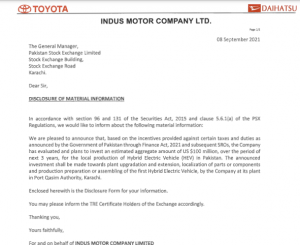
Indus Motor Company Limited (IMC), the makers of Toyota vehicles in Pakistan, has announced that it would invest $100 million in the local production of hybrid electric vehicles. The amount will be invested over the period of three years, said the company in its filing to the Pakistan Stock Exchange (PSX) on Wednesday.

“We are pleased to announce that, based on the incentives provided against certain taxes, duties as announced by the Government of Pakistan through Finance Act 2021, and subsequent Statutory Regulatory Orders (SROs), the company has evaluated and plans to invest an estimated aggregate amount of $100 million, over the next 3 years, for the local production of Hybrid Electric Vehicle (HEV) in Pakistan,” the company wrote in letter to Pakistan Stock Exchange (PSX).

The automotive manufacturing company said that the announced investment shall go towards plant upgradation, extension, localization of parts or components, and production preparation or assembling of HEVs.

“The production by the company shall be done in Port Qasim Authority, Karachi,” the statement added.

The announcement comes after Toyota Motor Corp, IMC’s parent company, said that it expected to spend more than $13.5 billion by 2030 to develop batteries and its battery supply system as the move to hybrid electric vehicles gathers steam. The federal cabinet on Dec.22 had approved Pakistan’s first Electric Vehicle Policy.

The motorcycles and vehicles would be shifted on electric power, while Electric Vehicle Manufacturing Units would also be established in the country. Under the new EV policy, the Sindh Transport Minister Syed Owais Shah back in March 2021 had launched Pakistan’s first electric bus in Karachi۔

Jazz records strong growth, increased by 21 % year-on-year to cross Rs57 billion.

Lahore (NUT-Technology)

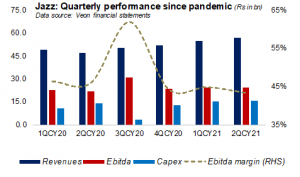
Pakistan’s leading mobile network operator (MNO) has had yet another strong quarter. Topline at Pakistan Mobile Communications Limited (‘Jazz’) increased by 21 percent year-on-year to cross Rs57 billion in the quarter ended June 30, 2021, as per latest financial results posted by its parent Veon earlier this week. Ebitda grew by 14.5 percent year-on-year in 2QCY21 to reach Rs25 billion, yielding a 43 percent margin. Size and strategy seem to be keeping Jazz in a well-assured position of market leader.

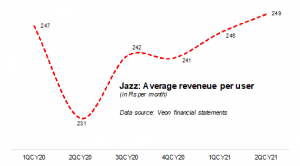
The pace of yearly growth in operating revenues last quarter was the highest than in any quarter since 1QCY19. The key indicator – Average Revenue per User (ARPU) – has perked up to Rs249 per month in the latest quarter, growing by 8 percent over the ARPU during 2QCY20. Both the core mobile services and data revenues have shown handsome growth, with the data business especially prominent. However, ARPU has some way to climb before catching up with the recent peak of Rs272 per month (1QCY19).

Buoyed by strong growth in data subscriptions as well as higher data usage, data revenues at Jazz reached almost Rs21 billion in 2QCY21, showing a 31 percent yearly growth and accounting for 37 percent of overall operating revenues. As of June end, there were over 48 million data customers with Jazz, which is an 18 percent expansion compared to June 2020. Overall ARPU is improving in tandem. Data growth has come in the midst of an active pandemic, as more and more people find it essential to use digital means for the purpose of work, commerce, social interactions, education and remote health. Within the Jazz data user base, the number of 4G users stood at nearly 31 million as of June 2021, recording a massive jump of 61 percent since June 2020.

The corporate strategy is to improve concentration of 4G users in the subscription pie, as data services stand a much more favorable chance of monetization compared to voice and text services. Investments are being made accordingly, as the MNO spent roughly Rs16 billion on capital expenditure during the quarter (10% YoY growth), mainly to expand 4G networks. It is financing its capital expenditures mainly from local credit facilities.

The investment shows in growing 4G coverage, which has increased for Jazz from 56 percent of population area in June last year to 64 percent in June 2021. The “scale” that Jazz has amassed over the years after acquiring Warid and expanding its data networks allows it to better manage the headwinds of low revenue growth and rising operating expenditures that are proving challenging for other operators.

At the close of half-year, Jazz is on a strong footing. Revenues have grown by 16.5 percent to Rs112 billion in 1HCY21, with strong growth in data revenues and double-digit hike in mobile service revenues as well. Ebitda growth in the period was a bit lower at 11 percent to Rs50 billion, as the MNO is making high marketing investments in its brands, mainly JazzCash, which is showing a significant increase in its monthly active users. Let’s see what kind of firepower Jazz brings to the spectrum auction in a few weeks.

Apple hit with antitrust case over in-app payments issues

Lahore (NUT-DESK)

Apple Inc (AAPL.O) is facing an antitrust challenge in India for allegedly abusing its dominant position in the apps market by forcing developers to use its proprietary in-app purchase system. The allegations are similar to a case Apple faces in the European Union, where regulators last year started an investigation into Apple’s imposition of an in-app fee of 30% for distribution of paid digital content and other restrictions.

The Indian case was filed by a little-known, non-profit group which argues Apple’s fee of up to 30% hurts competition by raising costs for app developers and customers, while also acting as a barrier to market entry.

“The existence of the 30% commission means that some app developers will never make it to the market … This could also result in consumer harm,” said the filing, which has been seen by Reuters.

Unlike Indian court cases, filings and details of cases reviewed by the Competition Commission of India (CCI) are not made public. Apple and the CCI did not respond to a request for comment.

In the coming weeks, the CCI will review the case and could order its investigations arm to conduct a wider probe, or dismiss it altogether if it finds no merit in it, said a source familiar with the matter.

“There are high chances that an investigation can be ordered, also because the EU has been probing this,” said the person, who declined to be identified as the case details are not public.

The complainant, non-profit “Together We Fight Society” which is based in India’s western state of Rajasthan, told Reuters in a statement it filed the case in the interest of protecting Indian consumers and startups.

In India, though Apple’s iOS powered just about 2% of 520 million smartphones by end-2020 – with the rest using Android – Counterpoint Research says the U.S. firm’s smartphone base in the country has more than doubled in the last five years.

The Apple case in India comes just as South Korea’s parliament this week approved a bill that bans major app store operators like Alphabet Inc’s (GOOGL.O) Google and Apple from forcing software developers to use their payment systems.


Pakistan earns US $2123 million from IT services’ export during FY 2020-21

Lahore (NUT-DESK)

Pakistan earned US $2123.035 million by providing different information technology (IT) services in various countries during the fiscal year 2020-21.  This shows growth of 47.44 percent when compared to US $1439.970 million earned through provision of services during the corresponding period of fiscal year 2019-20, Pakistan Bureau of Statistics (PBS) reported.

During the period under review, the computer services grew by 50.32 percent as it surged from US $1108.690 million last fiscal year to US $1666.615 million during July-June (2020-21).

Among the computer services, the exports of software consultancy services witnessed increase of 35.50 percent, from US $408.974 million to US $554.180 million while the export and import of computer software related services also rose by 30.88 percent, from US $318.937 million to US $417.415 million.

The exports of hardware consultancy services decreased by 71.84 percent from, US $1.957 million to US $0.551 million whereas the exports of repair and maintenance services also decline by 56.19 percent from $1.511 million to $0.662 million.

In addition, the exports of other computer services rose by 83.88 percent from US$ 377.311 million to US $ 693.807 million.  Meanwhile, the export of information services during the period under review increased by 56.47 percent by going up from US $ 2.550 million to US $3.990 million.

Among the information services, the exports of news agency services increased by 69.41 percent, from US $ 1.360 million to US $ 2.304 million whereas the exports of other information services also increased by 41.68 percent, from US $ 1.190 million to US $ 1.686 million.

The export of telecommunication services also witnessed an increase of 37.63 percent as these went up from US $328.730 million to 452.430 million during the fiscal year under review, the data revealed.

Among the telecommunication services, the export of call centre services increased by 22.10 percent during the period as its exports increased from US $ 125.964 million to US $153.806 million whereas the export of other telecommunication services also increased by 47.28 percent, from US $202.766 million to US $298.624 million during the period under review, the PBS data revealed.

Pakistan’s mobile phones production surpasses import

Lahore (NUT-DESK)

Adviser to Prime Minister for Commerce and Investment Abdul Razak Dawood said that the number of mobile phones manufactured locally has surpassed the number of devices imported during the period between January and July 2021.The production of mobile phones by local manufacturing plants has surpassed the number of mobile phones imports in the country. During Jan-July 2021, the production of mobile phones by local manufacturing plants was 12.27 million and imported mobile phones recorded at 8.29 million.

This trend reflects a positive uptake on PTA’s Mobile Device Manufacturing (MDM) Authorisation regulatory regime whereby local manufacturing within the first year of regime introduction has resulted in production of 12.27 million phones in a short span of seven months including 4.87 million 4G smartphones.

The successful implementation of Device Identification Registration and Blocking System (DIRBS) along with conducive government policies including the mobile manufacturing policy has created a favourable environment for mobile device manufacturing in Pakistan.

It has also contributed positively to the mobile ecosystem of Pakistan by eliminating counterfeit device market providing a level playing field for commercial entities and has created trust amongst consumers due to the formulation of standardised legal channels for all sorts of device imports.

It is important to highlight that the government of Pakistan introduced a comprehensive mobile manufacturing policy to encourage and attract manufacturers to establish their units in Pakistan. PTA in light of the policy issued Mobile Device Manufacturing (MDM) Regulations on January 28, 2021. Till now, 26 companies have been issued MDM authorisation enabling them to manufacture mobile devices in Pakistan.

Airlink set for biggest IPO at PSX

Lahore (NUT-DESK)

Airlink Communication Ltd, a cell phone distributor in Pakistan, is set for the largest ever Initial Public Offering of Pakistan’s private sector. The company has ventured into manufacturing recently – assembling TCL, ITel and Tecno cell phones in the country.

The company will be selling 90 million shares at a base price of Rs65 per share, which will amount to Rs5.85 billion in total at base price.

The book building will be held on August 30 and 31 and the price will be decided with institutions and high net worth individuals bidding via the Dutch auction method. The general public will be able to buy the company’s shares on September 6 and 7. JS Global Capital Limited is the consultant and book runner to this issue.

JS Global is set to bring the largest ever initial public offering of Rs6 billion to the capital market as the consultant and book builder of Airlink Communication Limited, a statement said.

Airlink Communication Ltd, a cell phone distributor in Pakistan, has ventured into manufacturing recently for the Transsion Group China. As a vertically integrated company, it also has retail stores for distributing top international smart phone brands like Samsung, Apple, Huwawei, Xiaomi, Itel, Techno, TCL and Alcatel.

The company would be selling 90 million shares at a base price of Rs65/share.

Airlink sales grew from Rs140 million in 2012 to over Rs47 billion in 2021, showing an unprecedented growth as e-commerce and digitisation continued to expand at a fast pace. All the big smart phone manufacturers such as Samsung, Itel, Tencho, Infinix, TCL and Alcatel would now be assembled in Pakistan. Further Xiaomi, the largest smart phone manufacturer of the world would also soon start assembling in Pakistan.

These big brands not only want to venture into Pakistan to fulfil the demands of the 5th largest population, but also aim to start exporting within the next 12-24 months, with bodes well for the country’s economy.

“We have seen the stock markets flourishing during the last 12 months and it is expected that on the back of the improving macro economic situation the markets will witness more IPOs and liquidity in days to come,” the statement added.

Pakistan Prosperity Index surges by 13% .

Lahore (NUT-DESK)

The Pakistan Prosperity Index (PPI), after taking a hit in April and May, grew by 13% in June due to the post-lockdown commercial activities.

A recent report by the Policy Research Institute of Market Economy (PRIME) said that the PPI had grown to an all-time high of 135.9 in June, driven by a surge in post-lockdown business activities.  The PPI is an agglomeration of trade volume, lending to the private sector, purchasing power and manufacturing output indices.

The trade volume increased Rs548 billion year-on-year (YoY) and Rs360 billion month-on-month (MoM) with the resumption of business activities and reopening of international markets.

Subsidized borrowing rates by commercial banks showed that the private sector had taken on a lot of credit as well, while, long-term financing facility stood at an all-time high of Rs390.8 billion in June 2021.

In the context of purchasing power, the YoY inflation was reported at 9.7%, while the MoM one clocked in at a negative 0.3%, a manifestation of improvement in purchasing power. The prevalent high levels of inflation are mostly because of a hike in food and energy prices.

Large Scale Manufacturing (LSM) increased by 4.36% MoM. This increase can be attributed to the higher demand emanating from the ease in lockdown, mass vaccination and opening up of business.

In addition, higher production costs fueled by higher energy prices, and supply-side disruptions of raw material all had a fair share in restricting LSM’s output. Notwithstanding, the overall economic outlook, as measured by PPI, seems to be encouraging.

The performance of the economy indicated by PPI is consistent with the latest Business Confidence Survey 2021 by Overseas Investors Chamber of Commerce and Industry (OICCI), which also illustrated the strengthening of business confidence and augmented growth prospects owing to an uptick in the business activities.

With the ease in lockdown restrictions and a mass vaccination drive, the overall state of the economy appeared encouraging and on a right track, the PRIME report said.The report, however, stressed that Pakistan needed to bring down inflation to increase purchasing power/real income of the masses and also to decrease the input cost of the LSM.

The study stressed that addressing the supply-side shocks of basic food items was pertinent to lower food inflation, which was the main cause of rising overall inflation in the economy. These supply-side shocks called for more liberal trade measures and elimination of state intervention in the market, the report added.